
Five Years of Founding, Innovation, Leadership — My Learnings from University
June 13, 2026
This post was translated into English by AI. Read the original →
Introduction
If I had to compress five years of studying into one sentence: you learn the most when you actually do something. Theory gave me the vocabulary and the tools, but the knowledge only stuck through real projects, with real people, real risks, and real failure. Here are the lessons that stuck.
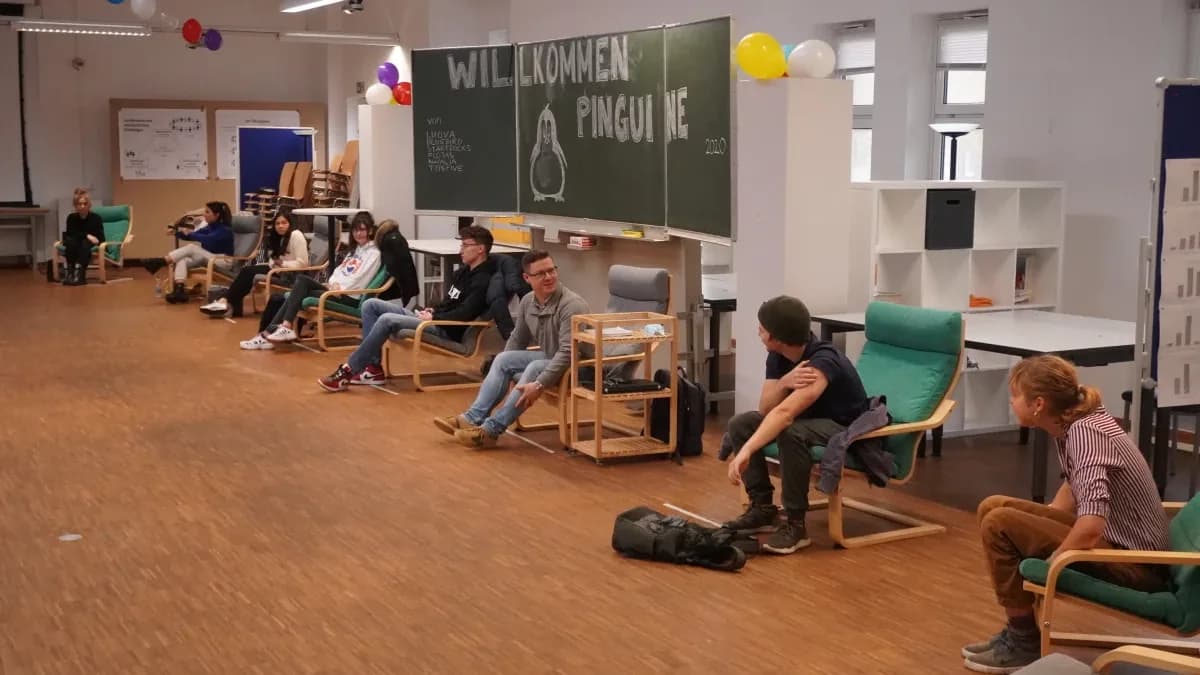
For over five years I studied Founding, Innovation, Leadership at Hochschule Bremerhaven. It's a program modeled on the Team Academy: no lecturing from the front, but problem-based learning in your own cooperative, with real projects, real customers, and real money. I worked through every module on a real venture — on the card game DEEP QUEST, on a rental platform for the Kulturamt, on the pop-up cultural center ZAPPZARAPP, on websites, on an ASCII printer made from an old typewriter, and finally on a bachelor thesis about networking Libraries of Things.
Going back through my old module submissions, I noticed how much had piled up over these years. I want to use this article to capture the most important insights in a single running list — roughly in the order I encountered them. It's less a summary of theory than what actually stayed with me.
My learnings
-
Dialogue is not discussion. William Isaacs showed me that thinking together only becomes possible once I stop wanting to be right. Suspending, listening, respecting, and articulating — these four core competencies change how I work in groups. A real pause in a conversation isn't a lost moment, but the space in which new thoughts can come into being in the first place.
-
I know my team role — and its dark side. The Belbin test confirmed what I'd suspected about myself: I'm a shaper, not a classic team worker. I get into doing quickly, but sometimes leave the planning phase too early and then miss things. Knowing this tendency is half the battle in deliberately steering against it.
-
Structure is my most important productive resource. A morning routine, time-blocking, and a to-do list curated the night before keep me on course. As soon as the routine breaks, I live through the day without a plan — restful in the short term, but in the long run it makes me dissatisfied and unproductive.
-
A cooperative is an ideal place to learn. A learning enterprise should be as cheap as possible to found and carry no personal risk. Grappling with legal forms, statutes, a team manifesto, and a business plan showed me how much you learn about entrepreneurship when you actually co-found one and don't just read about it.
-
Automation creates freedom. For DEEP QUEST we built a website with a shop system instead of selling through middlemen. Direct sales noticeably increased our profit, the automated checkout was less error-prone than orders via Instagram and WhatsApp — and an automated system can be extended and scaled at will.
-
You can reach your first revenue without start-up capital. DEEP QUEST made its first sales within a few weeks because we caught the Christmas season and bet on our own network. You don't have to calculate market potential perfectly — a rough estimate from secondary data is often enough to make a decision.
-
A good product doesn't sell itself. For a long time I thought marketing only ate budget and drove prices up. That's not true. Attention is work, and especially on a lean budget every contact counts. You have to check promotional measures for effectiveness continuously — not only at the end of the project — to focus on what works.
-
The network is the single most underrated resource there is. With help from the university, team coaches, friends, and family, we made possible things that would have been impossible alone. People like to help — you just have to take that help and know where to ask for it. In my projects in Bremerhaven, the network was at times the most important resource I had.
-
Reading is a tool, not an end in itself. Through the Free Reading modules I learned to read books with purpose and process them in book essays — from Factfulness through Building a StoryBrand to the post-growth economy and scientific writing. A book whose core idea I can reproduce in my own words is one I've really read.
-
Fact-based beats gut-based. Factfulness by Hans Rosling brought home to me how strongly instincts distort my worldview. Since then I check narratives more deliberately for their truth content — and see that "bad" and "getting better" aren't a contradiction.
-
Creativity can be observed and influenced. I analyzed when I'm creative and when a lack of ideas plagues me, and built a personal creativity manual from it. Creativity isn't chance that comes over you, but a state I can produce with the right conditions.
-
Visualization makes complexity tangible. Whether a database schema, an ERM, user stories, or an Excalidraw sketch — as soon as I draw a matter out, I understand it better and can explain it to others. Visualizing has become thinking on paper for me.
-
Agile doesn't mean planless. In project management I got to know the magic triangle, classic and agile process models, and above all Scrum and Extreme Programming. From Personal Extreme Programming I built myself a guide for software projects — structure that gives me freedom instead of restricting it.
-
Understand the problem first, then build the solution. Product development along discovery-and-delivery lines taught me not to fall in love with the first solution that comes along. Correctly framing the starting situation decides whether something gets created in the end that someone actually needs.
-
An MVP tests an assumption, not a finished product. In the Lean Startup Challenge I learned to test real customers' willingness to pay with minimal versions before investing time and money. Uncomfortable but instructive was the realization that I shy away from cold outreach — and that exactly there lies my biggest area for growth.
-
Focused work in a sprint beats multitasking. The sprint format — one week, one topic, one goal — was the most productive way of working in my entire studies. Without constant topic-switching and meetings, I get deeper into the matter and achieve more under less pressure.
-
There is no single right leadership style. As the cooperative's finance director and the initiator of my own projects, I learned to lead situationally and results-oriented. As Simon Sinek writes in Leaders Eat Last, at its core it's about extending trust and being willing to face the unknown. Leadership is above all listening and sensitivity.
-
An idea belongs in the open, not in a drawer. The rental platform for Bremerhaven's creative industries emerged at a barcamp at the Werk — in an open workshop with the people affected. Out of that conversation I was able to win over the economic-development office and finally the Kulturamt as the client. Innovation in networks means letting people think along early.
-
Travel is a form of study. Six months from Portugal through Morocco to Bilbao taught me more than some lectures could. On a FabFarm with a makerspace I combined craft, nature, and electrical engineering, visited another Team Academy in Bilbao, and saw along the way that you can work from anywhere. The shift in perspective on your own surroundings is priceless.
-
Accounting isn't a tedious evil, but steering. For the event series ZAPPZARAPP we applied for 6,000 € in funding and had to account for it cleanly. Understanding controlling, liquidity, and funding logic showed me: realizing an idea also means entering into a binding financial commitment.
-
A good research question is half the work. In scientific work I learned, using the example of short food supply chains, to systematically narrow a topic and substantiate it cleanly. That I only passed this module on the second try is just as much one of my learnings — sometimes it takes perseverance rather than talent.
-
You don't translate culture, you transcreate it. In the International Challenge I worked with the Hofstede model and the Sinus milieus and internationalized a website for the Danish market. Transcreation instead of literal translation and clean i18n are powerful tools for communicating to a specific audience — you have to plan cultural differences in from the start.
-
You have to analyze a network to lead it. While building our club project, we mapped our network and noticed that we were reaching institutions and politics but hardly the young subcultural scene the project was actually meant for. Looking at a network strategically reveals exactly such blind spots.
-
Communicate feelings, not resources. Brand building turned my view of communication around: instead of listing rooms, workshops, and offers factually, I have to address the needs and doubts of my audience and put people at the center of the story. Confuse and you will lose — coherent, simple messages are everything. And external communication begins inside the team: if the members disagree, no clear story is possible.
-
Strategy needs tools. SWOT, Porter's Five Forces, and a stakeholder map turned a vague vision into a business plan — in our case one aimed at the city. Strategic management means soberly understanding your own position in the market before investing money and energy.
-
Growth has more than one direction. The Ansoff matrix — market penetration, product development, market development, diversification — stuck with me as a simple but powerful grid for business development. It forces you to consciously decide where growth is actually supposed to come from.
-
Entrepreneurship means "to grasp." Etymologically, the entrepreneur is someone who grasps something and perceives it clearly. There's no single definition — and that's exactly what allowed me to formulate my own embodiment of entrepreneurship: less oriented toward profit, more toward the common good, sustainability, and solving real problems.
-
Running something is different from starting it. Working on the concept for taking over the ZAPPZARAPP cultural center made clear to me what it really means to run a club: you're the first to unlock and the last to turn off the lights — committed, every weekend. Two years ago we set off naively with the Novum Kollektiv; I didn't have that foresight back then.
-
The right technology is the one that fits the problem. For my websites I implemented A/B testing, localization, and structured data entirely without a CMS, using Next.js, Vercel, and a serverless setup. Webflow and Shopify are powerful, but oversized for my purpose. It's not the most powerful tool that wins, but the most fitting — and you should think about the architecture early.
-
You can overreach — and still learn a lot. With the ASCII printer made from an old typewriter, I originally wanted to run an AI chatbot through the keyboard. That was too big. Through the keyboard matrix, shift registers, and multiplexing I learned a lot, but above all to set the scope of a venture realistically instead of failing at my own ambition.
-
Organizational culture quietly has a say. According to Edgar Schein's model, the truly formative basic assumptions of an organization lie invisibly below the surface. Culture isn't soft decoration — it influences motivation and success often more strongly than any strategy.
-
From building to vision. My bachelor thesis on the strategic networking of Libraries of Things emerged exactly where my studies began: at a concrete piece of software for the city. Out of the insight that many committed initiatives solve the same problems in isolation grew the wish to widen the view. The greatest impact often lies not in the better technical solution, but in shared infrastructure and a forceful voice.
Conclusion
Reading this list, I notice a common thread running through all the modules: you learn the most when you actually do something. Theory gave me terms and tools, but the knowledge only anchored itself in real projects with real people, real risks, and real failure. Not every module was a fireworks display of insight, and not every project worked out — but it's exactly this mix of doing, reflecting, and doing again that I take away from Founding, Innovation, Leadership.