
Kulturdepot – Rental Platform for Bremerhaven's Cultural Scene
May 7, 2026
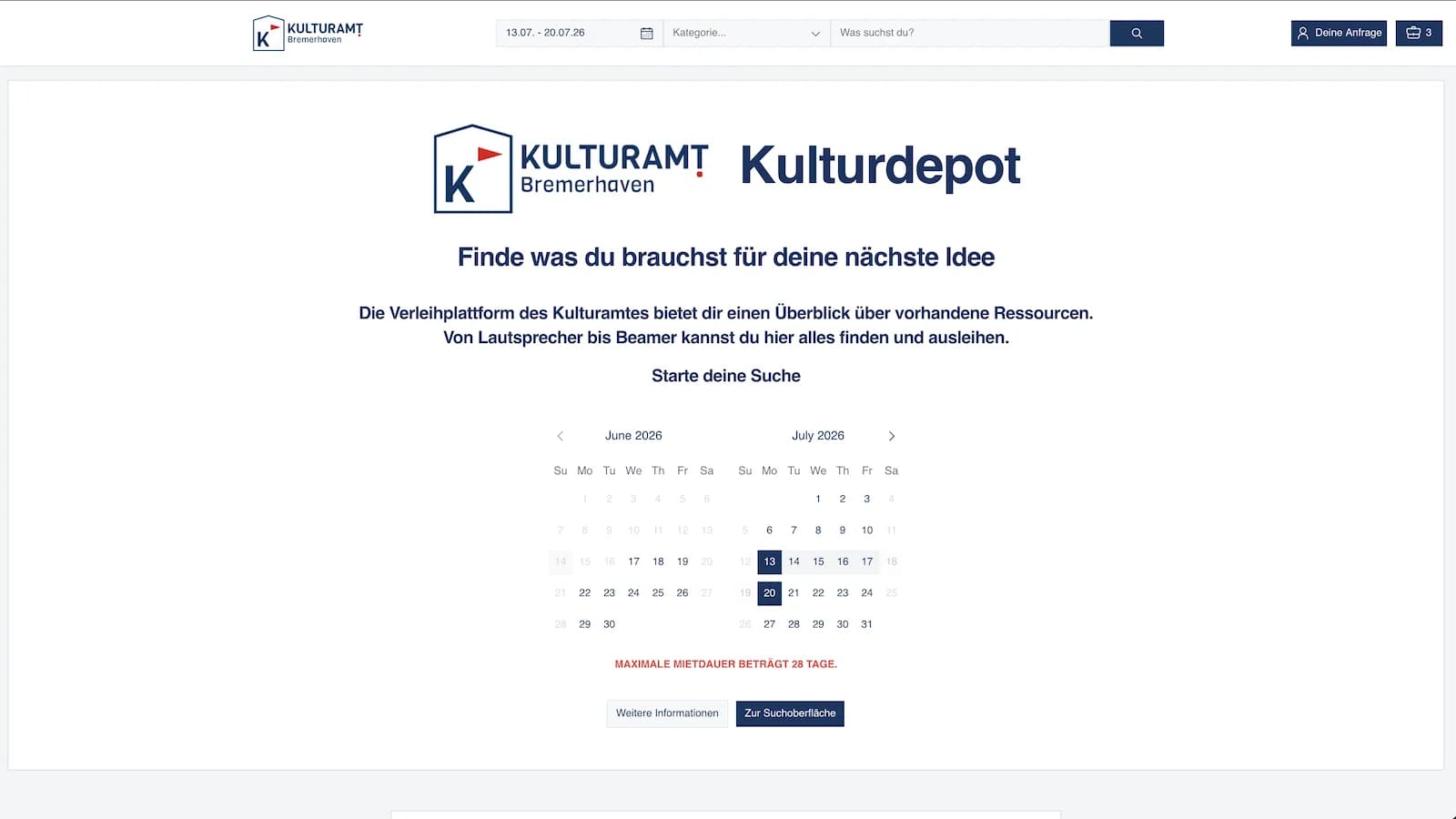
I had AI write most of this post. This lets me revisit and document older projects.
Project description
Kulturdepot is a digital rental platform I'm building together with Bremerhaven's Kulturamt (cultural office): a "library of things" for event equipment, letting people from the independent art and culture scene request and borrow technology, props, and materials owned by the city.
The idea isn't new — it comes from a concept I developed during my studies in 2024. Since spring 2026, I've been turning it into a real platform: Next.js, Payload CMS, PostgreSQL, and a full rental workflow with booking rules and payment processing.
The idea: "never again" hunting for equipment
Kulturdepot started from my own experience co-organizing events with the Novum Kollektiv. For our first event at the Kolumbusbahnhof — a big success with around 350 visitors — we had to gather equipment from completely different places: a sound system from the Kulturamt, carpets from Werk e. V., curtains from Rock-Cyclus e. V., a fog machine from the student union (AStA), lighting from "Das letzte Kleinod", and video material from the Seestadtarchiv. That only worked because we already had contacts at all of these places from other projects.
That's the core problem: the city's resources — event technology, rooms, props — sit in disconnected systems across different organizations. There's no shared overview. Unused surplus at one organization meets shortages at another, newcomers don't know who to ask, and organizations buy things that already exist elsewhere, unused.
Concept: a digital self-management platform
Out of that frustration came the 2024 concept for a digital self-management platform for people in the independent art and culture scene: a central place to structure and discover resources, knowledge, and infrastructure — searchable, filterable, and acting as a neutral broker between organizations and individuals.
Three requirements were central: a radically simplified interface usable regardless of education, language, or digital literacy; no thematic focus, so equipment for electronic music is covered just as well as costumes and props for theatre; and collective growth, with other organizations and individuals eventually able to add their own resources.
Architecture & tech stack
Kulturdepot is a Next.js app (App Router) with Payload CMS 3 as a headless backend,
using PostgreSQL (@payloadcms/db-postgres), S3-compatible storage via MinIO in
Docker Compose, Lexical as the rich-text editor, shadcn/ui and Tailwind CSS for the
frontend, German/English i18n, and Vitest/Playwright for integration and end-to-end
testing.
Data model: objects, categories, requests
At the core is the Objects collection — every item with title, brand, model, description, price, available quantity, images, and a category/subcategory. Example categories include event accessories, lighting, power supply, power cables, video, and audio equipment.
Borrowing happens through Requests: contact details, a date range, the requested
objects as line items, and a status that moves from PENDING through
PAYMENT_RECEIVED and APPROVED to COMPLETED or CANCELLED, with a full status
history. The model is rounded out by brands, documents, users, media, and a global
settings object for opening hours and rental configuration.
The rental process
Users search and filter by category, view an object page with an availability calendar, and
go through a multi-step checkout that creates a request. Fixed rental rules apply: bookings
can be made at most 6 months in advance and at least 3 days ahead, rental periods run from
1 day to 4 weeks, and pickup/drop-off happens Monday–Friday, 10am–2pm (or by arrangement).
Payment is integrated via the Kulturamt's payment service, which automatically moves
requests to PAYMENT_RECEIVED, and invoices follow a sequential numbering scheme.
Current status & open items
Since April 2026 I've been actively building Kulturdepot, step by step. Search, object pages, checkout, and the core rental workflow are in place; open items include end-to-end testing, performance and error handling, access control for documents and admin areas, and UI polish for mobile. The next milestone is a pilot run with a small group of users from Bremerhaven's cultural scene.
What I learned
Turning a 2024 concept into a real project only happened through the actual collaboration with the Kulturamt. Modeling a rental system in Payload CMS — objects, categories, brands, requests with a status workflow, documents — was a different scale than my previous, more static projects. Docker with Postgres and MinIO let me mirror production infrastructure locally. And rental booking rules (lead times, max duration, fixed pickup windows) had to be part of the data model from day one, not bolted on afterwards. The broader question of how similar platforms across Germany could be networked together is what I explored in my bachelor thesis on Libraries of Things.
Conclusion
Kulturdepot grew out of a simple "never again": never again spending hours hunting down equipment for an event. That frustration turned, through my studies and the collaboration with the Kulturamt Bremerhaven, into a real software project — Next.js, Payload CMS, PostgreSQL, and a complete rental workflow. The project is live at kulturbeta.bremerhaven.de, with a pilot run with real users from Bremerhaven's cultural scene as the next milestone.