
DEEP QUEST – A Card Game for Deep Conversations
December 15, 2020
This post was translated into English by AI. Read the original →
Project description
DEEP QUEST is a card game in business-card format (85 × 55 mm) with 45 cards: 40 question cards for deep conversations, three blank cards to design yourself, one rules card, and a QR-code card that leads to an online community. The idea behind it is simple: instead of small talk, the questions should get people to really get to know each other — whether on a first date, among friends, or in the shared-flat kitchen.
The game came about in 2020 as a project by a five-person team — Selma Niedermeier, Joel von Storch, Janek Holsten, Samuel Kotzan, and me — as part of our studies at Hochschule Bremerhaven. Together we developed the game, financed it through a crowdfunding campaign on Startnext, produced it, and marketed it.
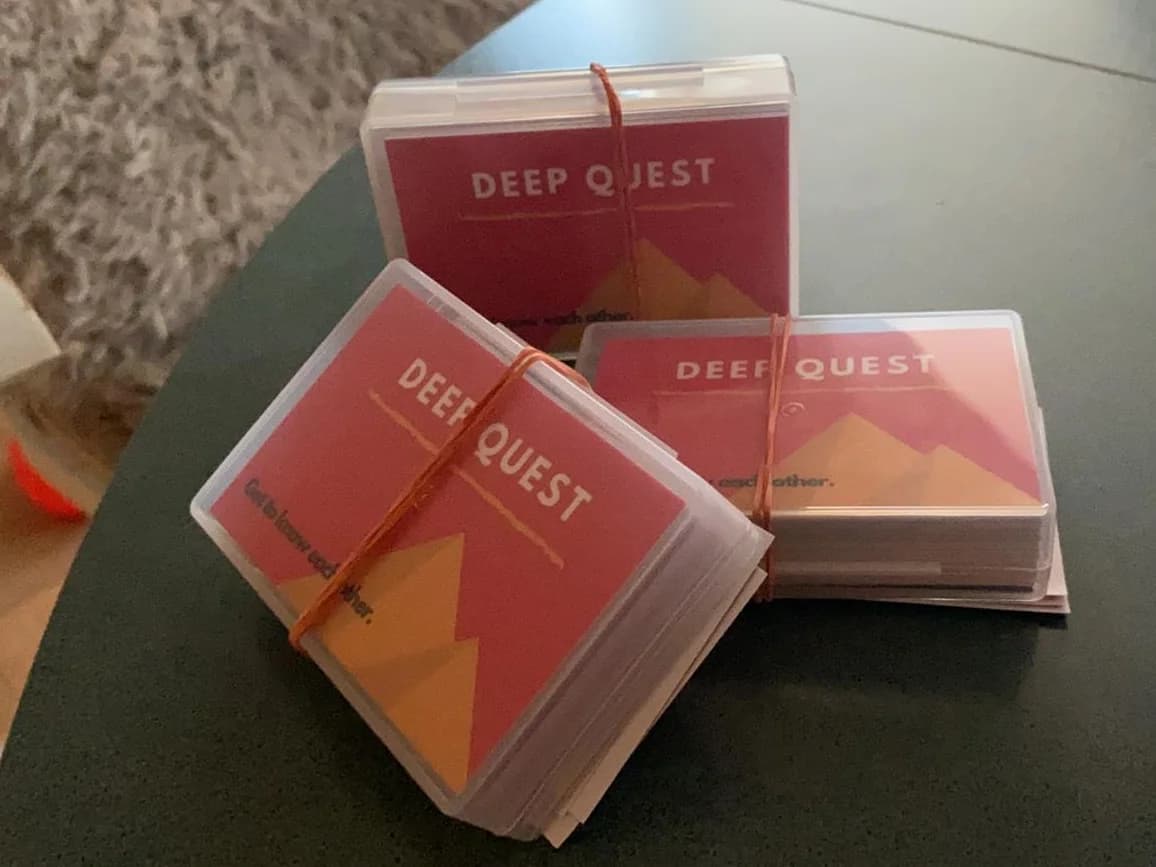
The finished, produced DEEP QUEST card decks — ready for packaging and shipping.
Idea and team
The starting point was an ideation workshop of the student cooperative Synto eG, in which students from different disciplines came together to develop a business idea. Out of numerous proposals came the idea for a card game that brings people together beyond superficial small talk — inspired by concepts like Vertellis and Kylskapspoesi, but with its own ambition and its own collection of questions.
The workshop turned into a committed team that carried the idea over several months, from the first question to the ship-ready product.
From question to product
The core of the game is the questions — and that's exactly where the work began. In an extensive brainstorm we first collected 53 possible questions, which we then discussed, tested, and condensed down to the 40 strongest questions for the final version. What mattered to us was a mix of easy opening questions and questions that really make you think.
The card design was made with Canva — pragmatic, low-cost, and without needing a dedicated design team.
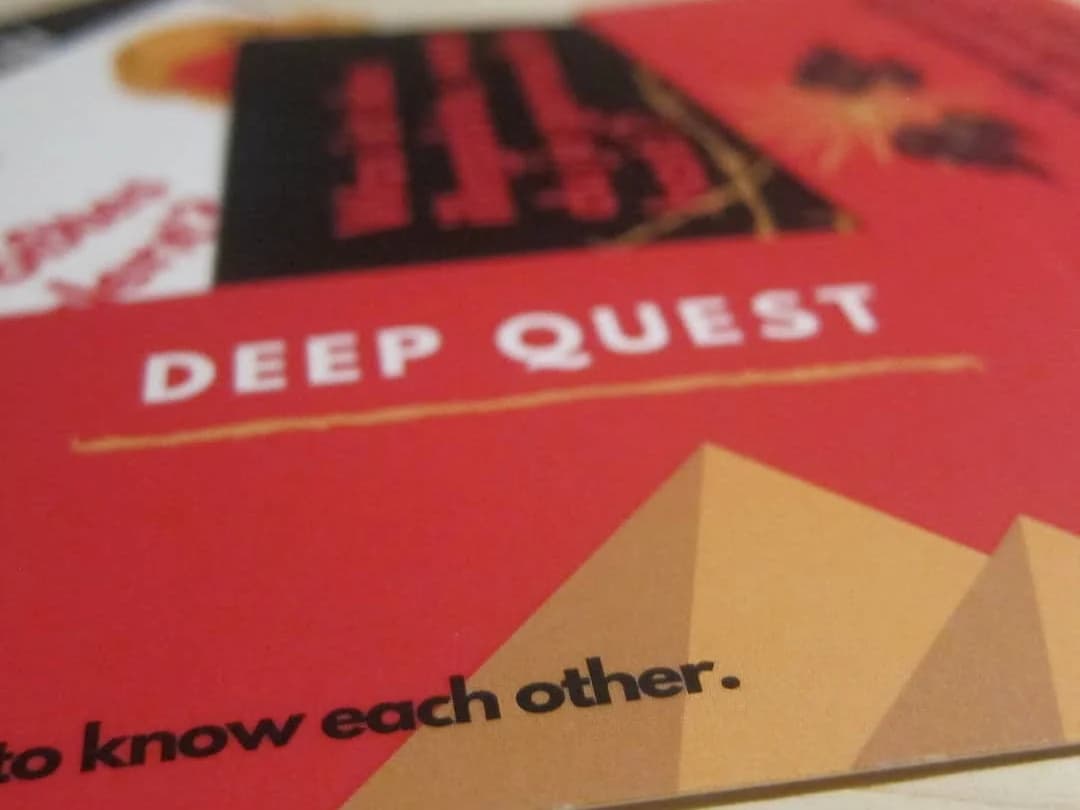
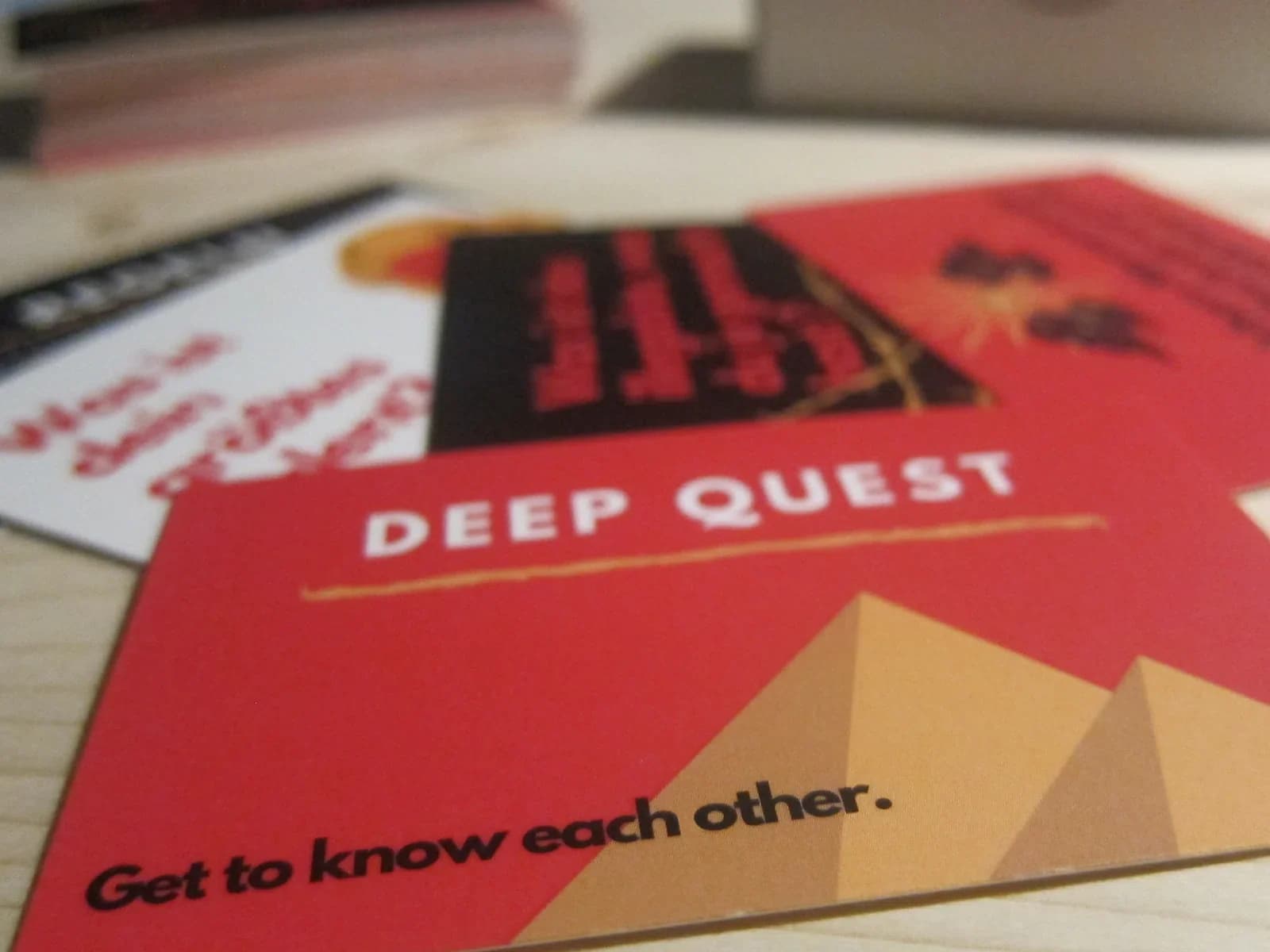
One of the 40 question cards in the finished design — business-card format, clear typography, bold colors.
For production we deliberately researched and compared: online print shops and the Chinese provider Yison Printing were cheaper, but would have meant long delivery times and less direct contact. Instead we chose Kleingedrucktes, a local print shop in Bremerhaven — short distances, personal contact, and the option to check proofs directly on site tipped the scales. Depending on the quantity, the quotes ranged between around 311 € for 100 units and 694 € for 300 units. For the packaging, too, we decided against elaborate, individually printed cardboard boxes and in favor of simple, transparent plastic packaging — high-quality enough, but considerably cheaper.
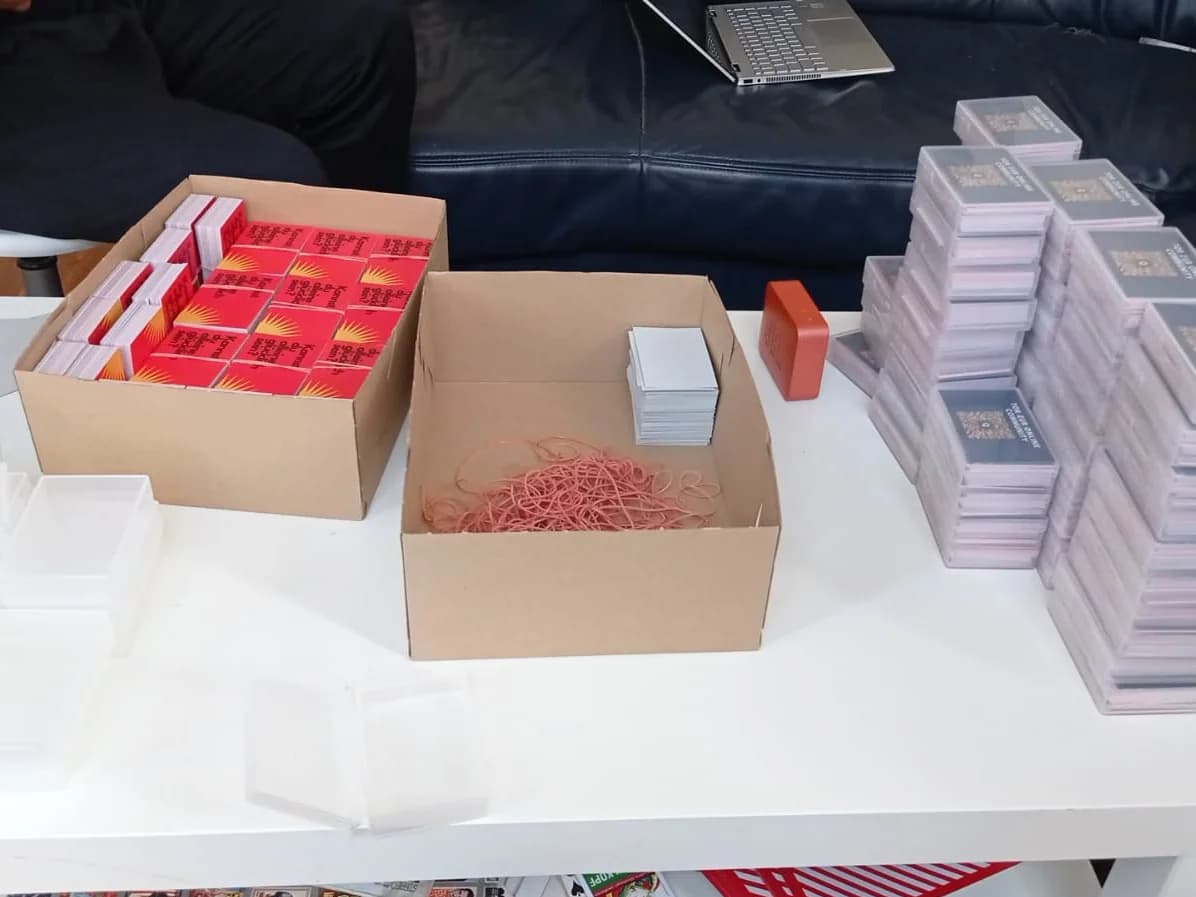
Freshly produced decks in the "Heimatbox" packaging, plus the "Gateway to the online community" cards, ready to pack.
Goals for the campaign
For the Startnext campaign we set ourselves three SMART goals:
- Reach the 600 € funding limit within the first 7 days
- 200 games sold within 19 days
- 500 € profit by January 1, 2021
These goals were deliberately ambitious, but realistic enough to serve as a genuine benchmark for our marketing work.
Marketing on a lean budget
Without a notable advertising budget, we had to get creative. Beforehand we created market, customer, and competitor analyses (including on Vertellis, Kylskapspoesi, and Sondermoment), ran a SWOT analysis, and sharpened our positioning via Simon Sinek's Golden Circle and Porter's competitive matrix. Out of that came a marketing mix of mostly free or very cheap measures:
- The Startnext page itself as the central hub with video, images, and storytelling
- Activating the personal network of all team members as the first supporters
- Press work, including an article in the Nordsee-Zeitung about the Bremerhaven student project
- A dedicated Instagram channel (@deepquest_de) for insights into the making of
- A promo video on YouTube presenting the game idea and team
- Professional product photos of the cards and packaging
- A "Heimatbox" campaign as well as visibility via the university website
- Support from Starthaus Bremen (Schotterweg location)
- Game nights, where we had people test the game live and gathered direct feedback
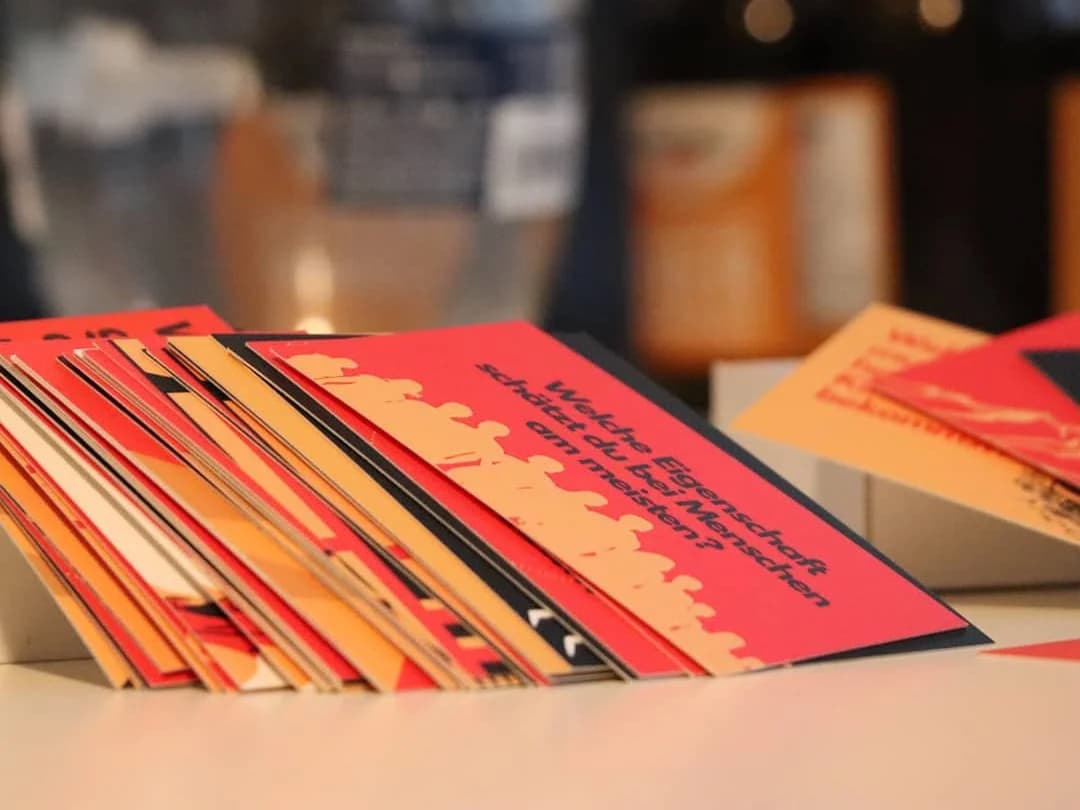
One of the product photos we used for Instagram and the Startnext page.
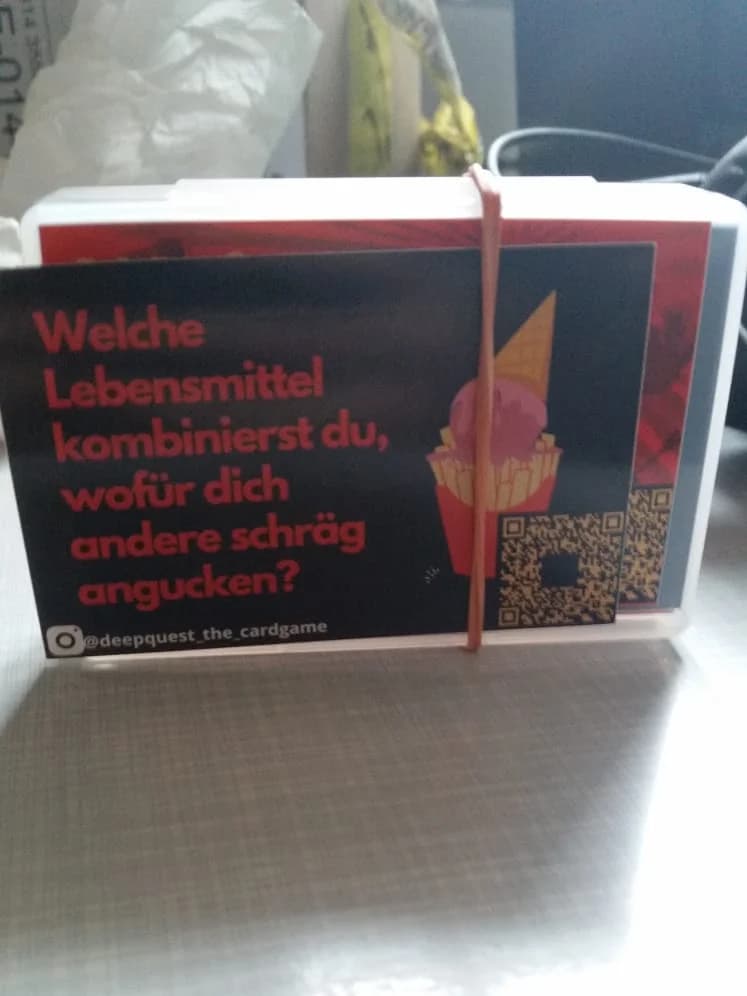
Every box contained a card with a QR code to our Instagram channel — a simple, free way to keep buyers tied to the brand.
Result of the campaign
The campaign ran from November 26 to December 15, 2020 on startnext.com/deepquest — with the following result:
- Goal 1 (600 € in 7 days): reached with 820 € — 136%
- Goal 2 (200 games sold in 19 days): 166 games sold (96× one game, 34× two games, 2× with gift option) — 83%
- Goal 3 (500 € profit by Jan 1, 2021): gross profit before tax of 1,073.32 €, real profit of around 900 € — 180%
Two of three goals were thus clearly exceeded, the sales goal narrowly missed — overall a very positive result for a student project with no external budget. Pre-financing and accounting were handled through the cooperative Bluebird eG, and shipping was done via DHL book and goods dispatch for 2.20 € per game.
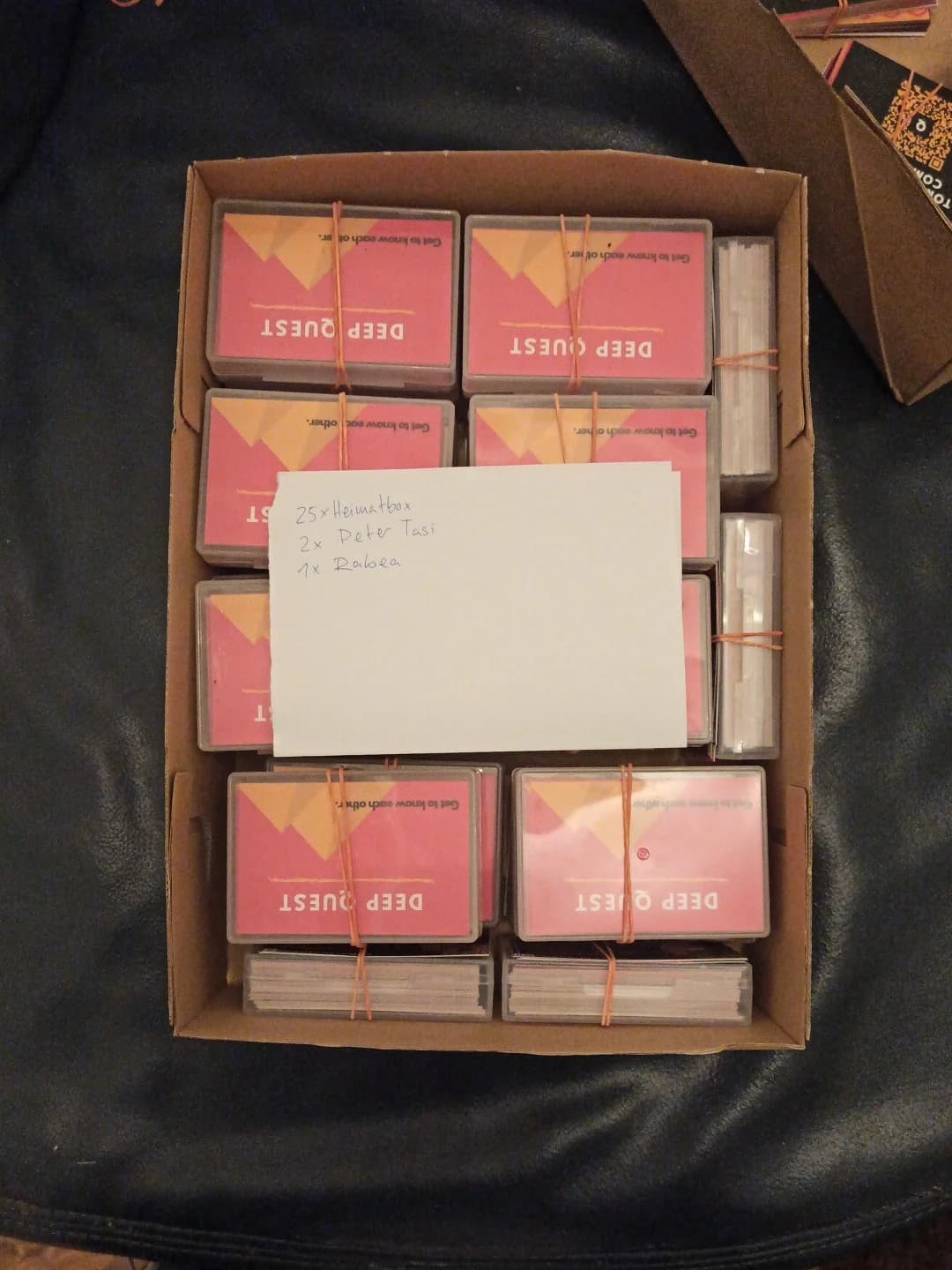
Packed orders, including the "Heimatbox" parcels — hand-sorted by recipient.
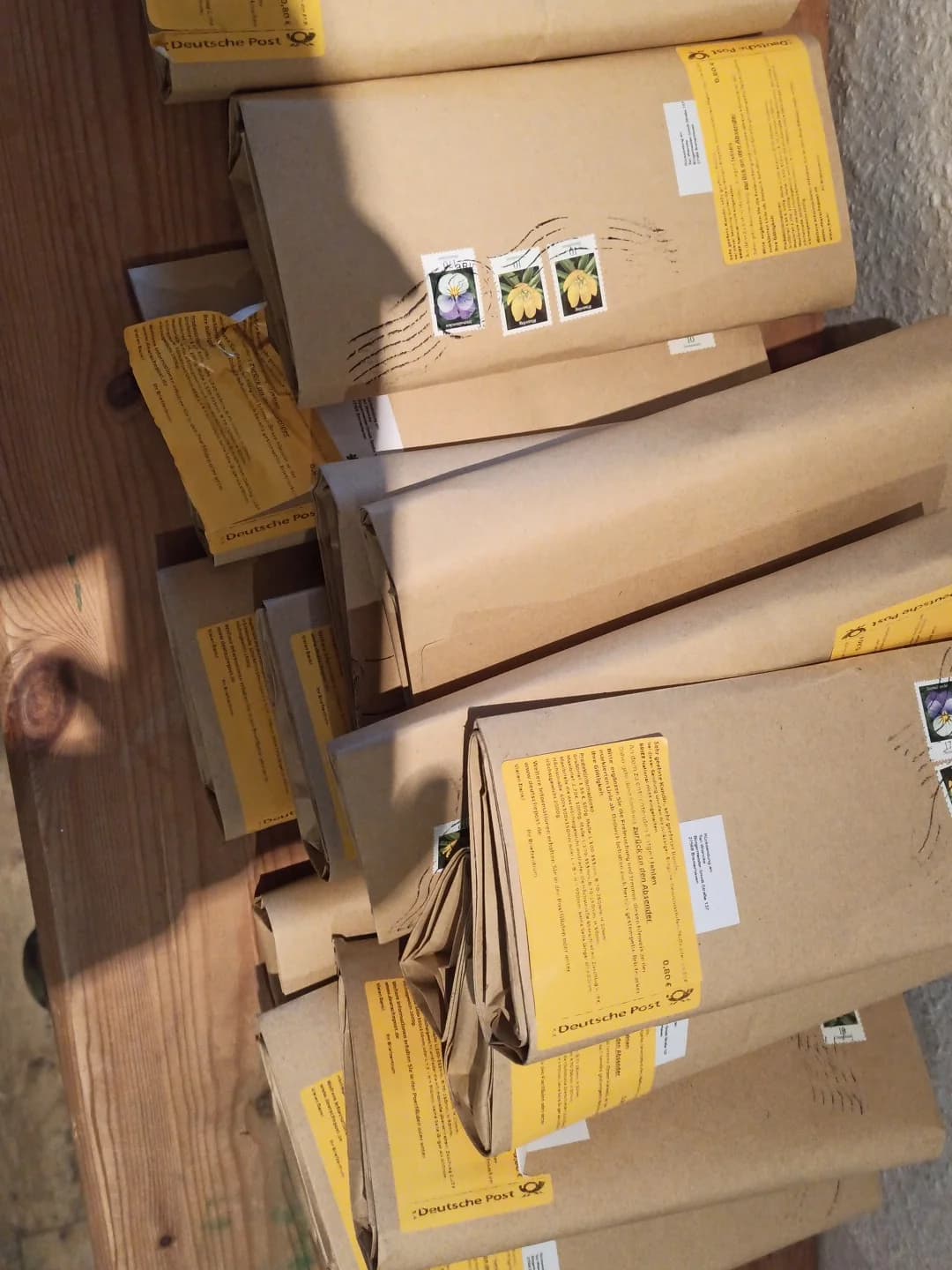
Shipping was done via DHL book and goods dispatch — here, part of the packed orders just before drop-off.
Without start-up capital: how Bluebird eG pre-financed production
One of the central questions of the Business Initiative Challenge was: how do you bring a product to market when you don't yet have your own business account? At the time of production, we as a team didn't yet have our own cooperative with a bank account. The solution: we presented our idea to the existing cooperative Bluebird eG — and it was willing to pre-finance production and receive the payout from Startnext.
On a "DEEP QUEST" sub-account at Bluebird eG, the following entries arose over the course of the project:
- 2020-12-16: −95.27 € for 200 plastic packages
- 2021-01-04: +150.00 € from Flotas eG for 25 card games at a special price
- 2021-01-05: −590.31 € to Kleingedrucktes for printing 200 card games
- 2021-01-05: +1,608.90 € payout from Startnext
This resulted in a profit before tax of 1,073.32 € — a goal-achievement rate of 180% against our goal of 500 €. We covered the costs for shipping and stickers privately and didn't include them in this calculation; the real profit was around 900 €. As soon as we had our own business account, we issued Bluebird eG an invoice to transfer the profit.
The choice of crowdfunding platform also involved the question of cost: Startnext charges the same transaction fees as Kickstarter, but only requires a commission of at least one percent — Kickstarter takes a fixed 5%. For a project without start-up capital, every percentage point matters.
The website deep-quest.de
In the following semester I built the website deep-quest.de together with Janek Holsten as a standalone project — including an online shop. Technically it's based on WordPress with the Divi theme (including a child theme), hosted at ALL-INKL.COM, and uses WooCommerce for sales. The setup was rounded out with plugins for a single-page checkout, PayPal payments, an Instagram feed, a GDPR-compliant cookie banner, Hotjar, and Jetpack.
In the final target-vs-actual analysis we reached 80.54% of the defined requirements — what was missing above all was a rating or feedback function for customers. As the biggest open points, we identified concluding data-processing agreements for GDPR compliance and a missing SEO and marketing strategy, which was reflected in low visitor numbers after launch.
Looking back: four years later
In 2025 I looked at the project again from a distance as part of the Business Initiative Challenge. It was especially interesting to see how many of the decisions back then — choosing Startnext over Kickstarter for lower fees, local production over a cheaper foreign print shop, the pragmatic handling of packaging and shipping — were in hindsight exactly the right levers for bringing a real product to market on a small budget.
Looking at the project again, I noticed how casually and "worthlessly" I had filed it away after finishing. Yet within a few weeks we developed and successfully implemented an idea — and found solutions to cover production costs despite the lack of start-up capital. Barbara Schieferstein from BIS Bremerhaven still remembers the project to this day, and a friend still plays the game with others. I myself no longer own a copy.
From today's perspective, two things bother me most: the simple plastic packaging that didn't close properly — a contradiction to the claim of being an innovative, young, sustainable project — and the patchwork card design made from stock images rather than our own illustrations. According to feedback, the product nonetheless fulfilled its purpose. The lesson: what matters isn't how a result came about, but whether it creates real value for the users.
This insight also shapes my current project: for the rental system for the Kulturamt (Kulturdepot), I deliberately took the time to program every feature from the ground up myself, instead of falling back on an existing solution like WordPress or Shopify — with the goal of ultimately delivering exactly the value that DEEP QUEST achieved back then, despite all the compromises.
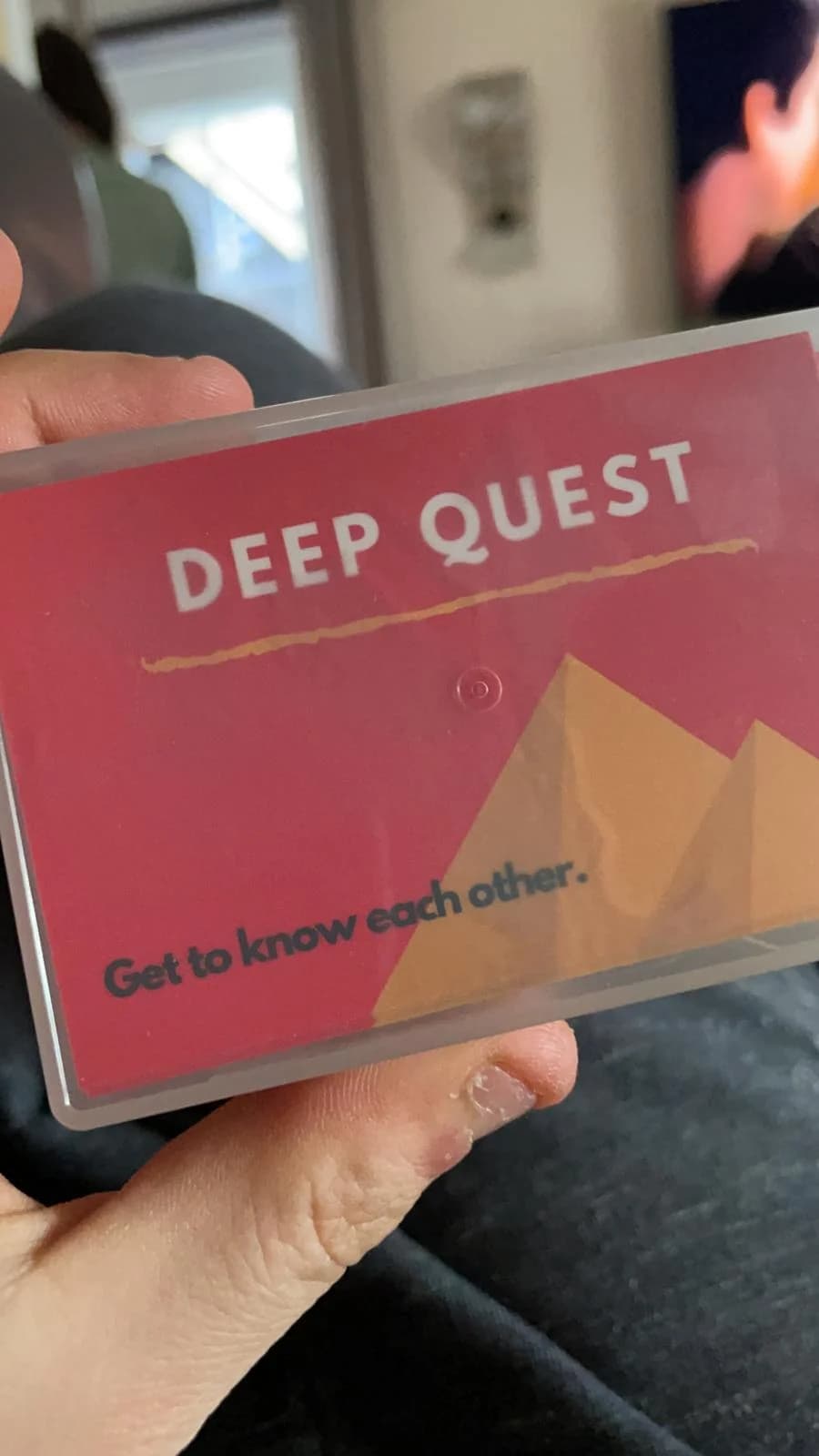
The finished product, packed and ready to ship.
What I learned
DEEP QUEST was, for me, the first full run-through of a product project — from the first idea through production and financing to sales and our own selling platform:
- How to plan a crowdfunding campaign, give it SMART goals, and steer it during its run
- How far you get with marketing without a budget when you consistently use your network, storytelling, and local press
- How important production and supply-chain decisions (local vs. cheap, packaging, shipping) are for cost and pace
- How to organize financing and accounting as a team and via a cooperative structure (Synto eG, Bluebird eG)
- How to set up a WooCommerce shop — and that a website without an SEO and marketing strategy isn't enough on its own
Conclusion
An idea from a workshop became a finished card game that was successfully financed, produced, and sold — with a profit that exceeded the original goal by 80%. The game is still findable today via startnext.com/deepquest and @deepquest_de. For me, DEEP QUEST was proof that a small team with a clear idea, honest communication, and a lot of initiative can bring a real product to market — even without a big budget behind it.
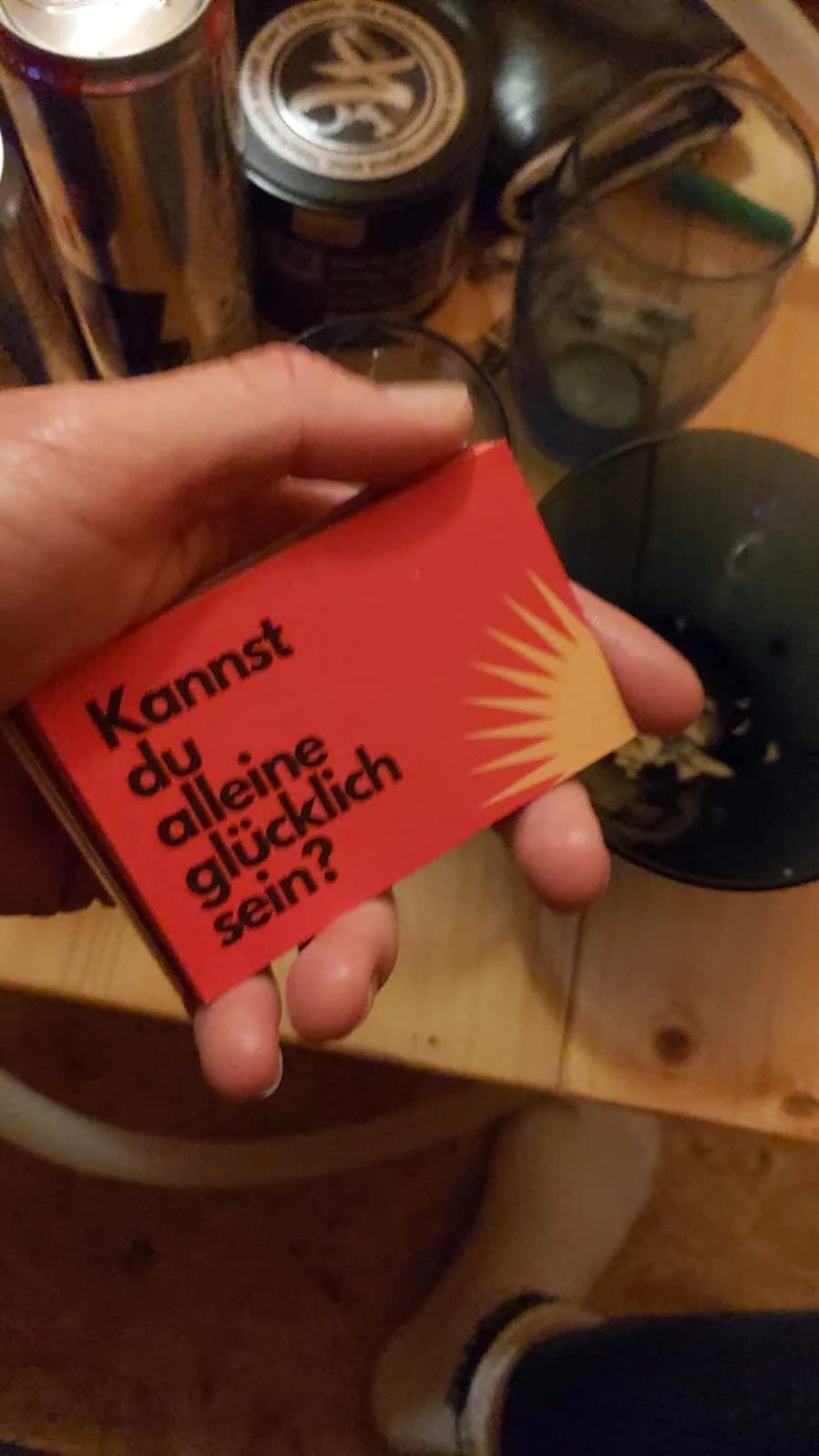
"Can you be happy alone?" — one of the 40 questions that make up DEEP QUEST.