
FabFarm Portugal – Off-Grid Living and the Aqua-Man Project
January 31, 2023
This post was translated into English by AI. Read the original →
Project description
In the winter of 2022/2023 I spent several months on a FabFarm near Lagos in the Algarve — a remote off-grid farm with its own makerspace. It was one stop on a roughly six-month journey that took me from Portugal through Morocco to Bilbao. Instead of the gray northern-German winter, there was sun, self-sufficiency, and the chance to combine craft, nature, and electrical engineering in everyday life.
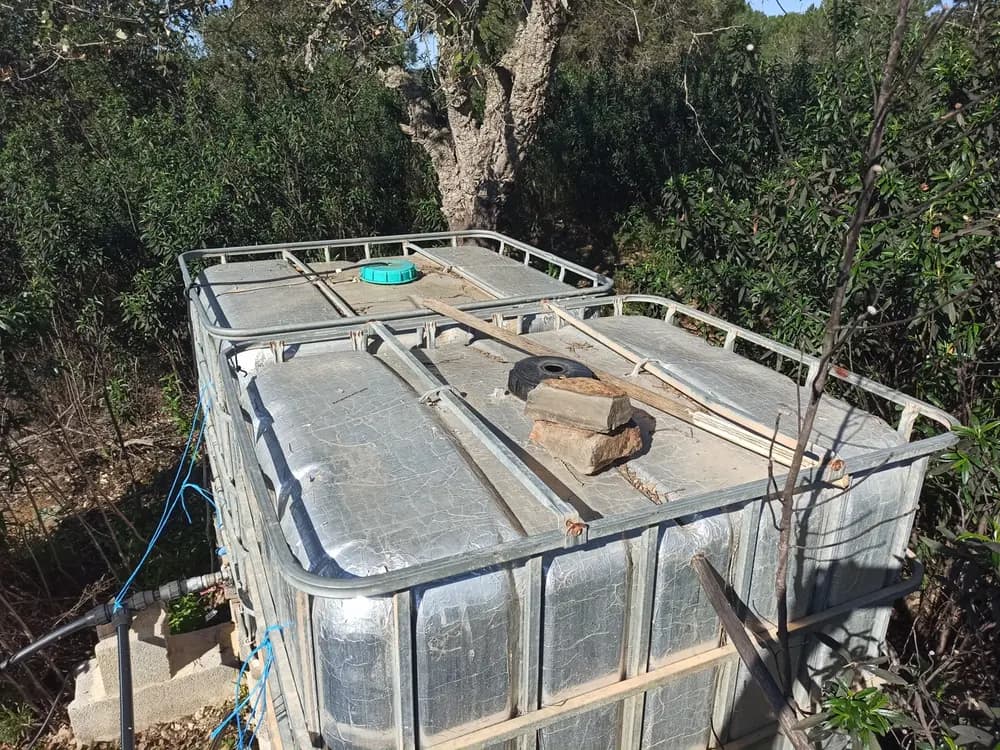
Two water tanks holding 2,000 liters in total supply all of the FabFarm's facilities with fresh water.
This article looks back on that stay: on the life and the people on the farm, on a small electronics project called Aqua Man that came about there, and on a phase in which not everything went according to plan.
The FabFarm: living and working off-grid
The FabFarm supplies itself with water, energy, and many of the materials for the makerspace. Two large water tanks holding 2,000 liters in total are installed halfway up the slope and supply all of the farm's facilities in the valley below. The water pump was already connected via a relay to a microcontroller and integrated into the local Home Assistant network — a good example of how much self-built automation goes into a place like this.
People from all over the world met on the farm, often for several weeks or months. Some came for the makerspace, others for the idea of off-grid living itself. I remember, for example, Chad from Vancouver, Canada, who was looking for his own land to try out whether an off-grid lifestyle was something for him, or Kamil from Colombia, who joined for a while. And of course Lobao, the farm's big dog — "sit" for him was "Stanta."
Aqua Man: measuring water level without a power grid
Out of everyday life on the farm came a small but, for me, very instructive electronics project: Aqua Man. The starting point was simply put — I wanted to measure the current fill level of the two 2,000-liter water tanks with an ultrasonic sensor and feed the data via ESPHome into the local Home Assistant network, in which the water pump was already integrated.
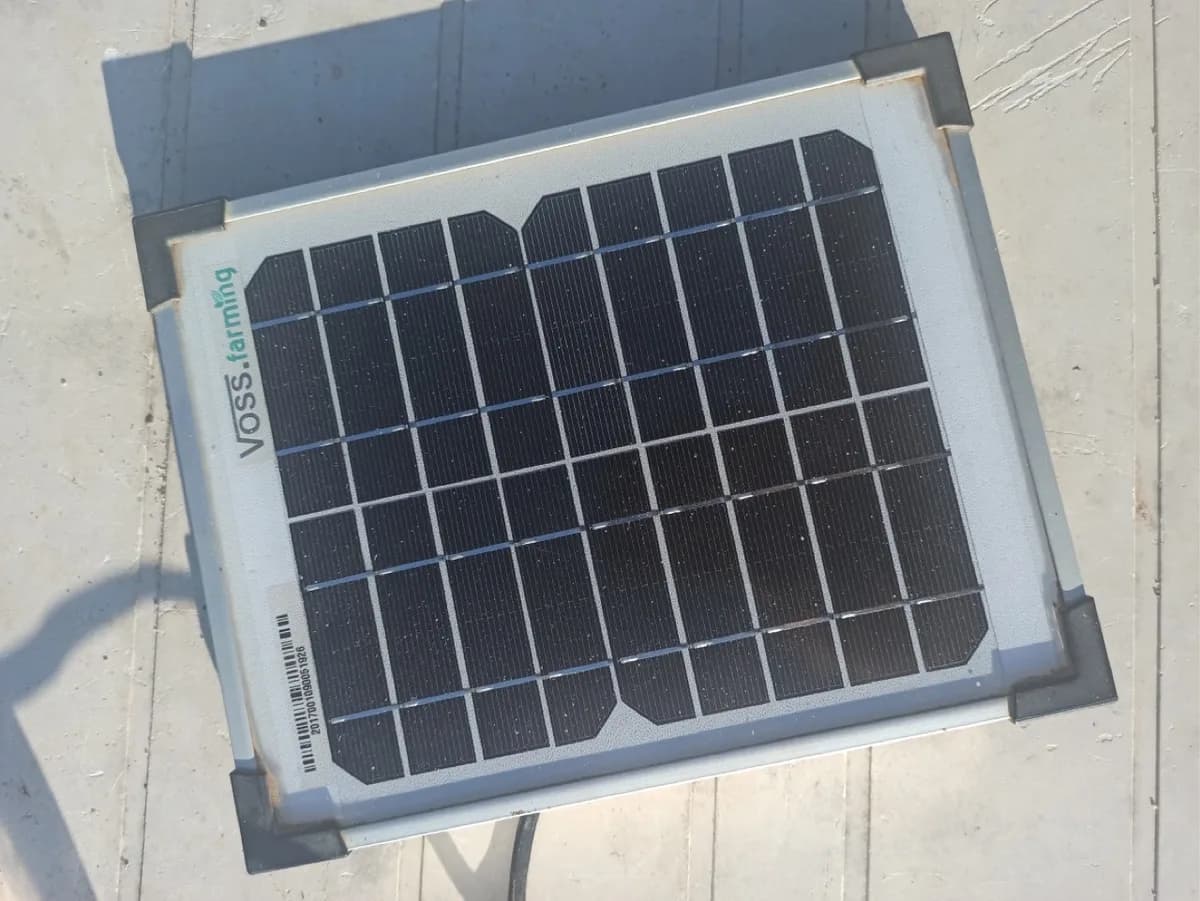
The power supply for Aqua Man had to work completely self-sufficiently — solar panel, battery, and charging electronics in a weatherproof enclosure.
From that came clear requirements for the system. It had to:
- have a self-sufficient power supply,
- communicate with the local Home Assistant server via WiFi,
- be able to store surplus energy,
- work very efficiently,
- withstand all weather conditions, and
- resist heat and direct sunlight.
Based on these requirements, I chose the following components:
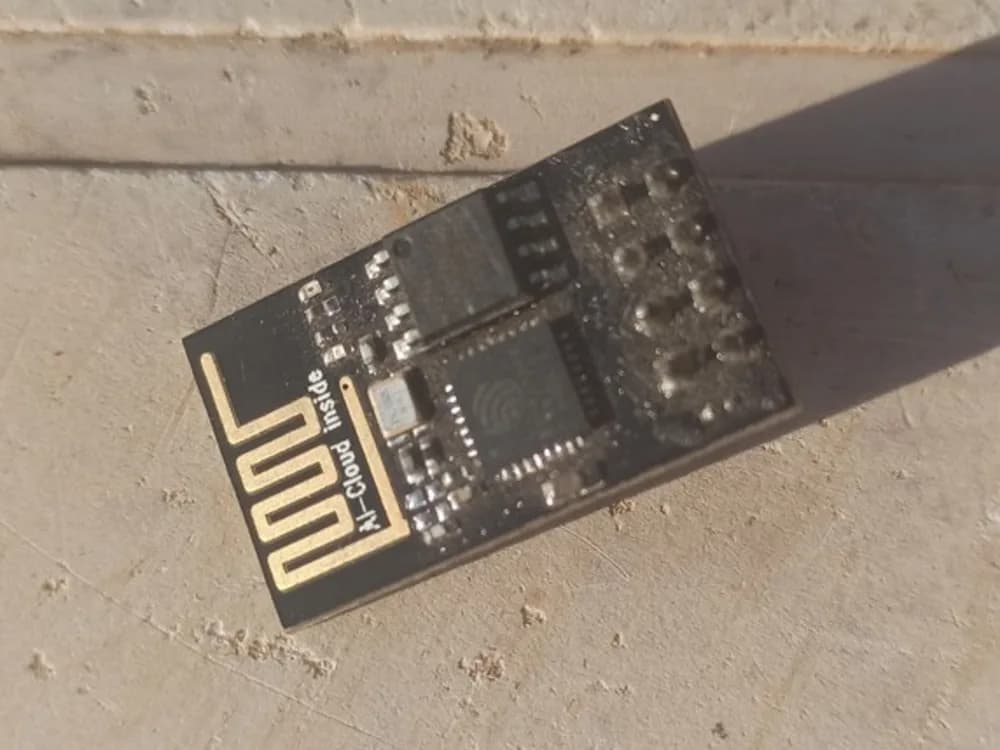
The ESP01 — a cheap WiFi microcontroller based on the ESP8266 that runs at 3.3 V and needs very little power.
- ESP01: a compact, cheap WiFi microcontroller based on the ESP8266 chip. It runs at 3.3 V and needs little power — ideal for a solar-powered application.
- Grove – Ultrasonic Ranger V2.0: measures the distance to the water surface in the tank via ultrasound. Unlike the widespread HC-SR04, this sensor also runs at 3.3 V and shares the trigger and echo signal over a single pin — so it can use the same power supply as the ESP01. Measuring range: 2–350 cm, resolution: 1 cm.
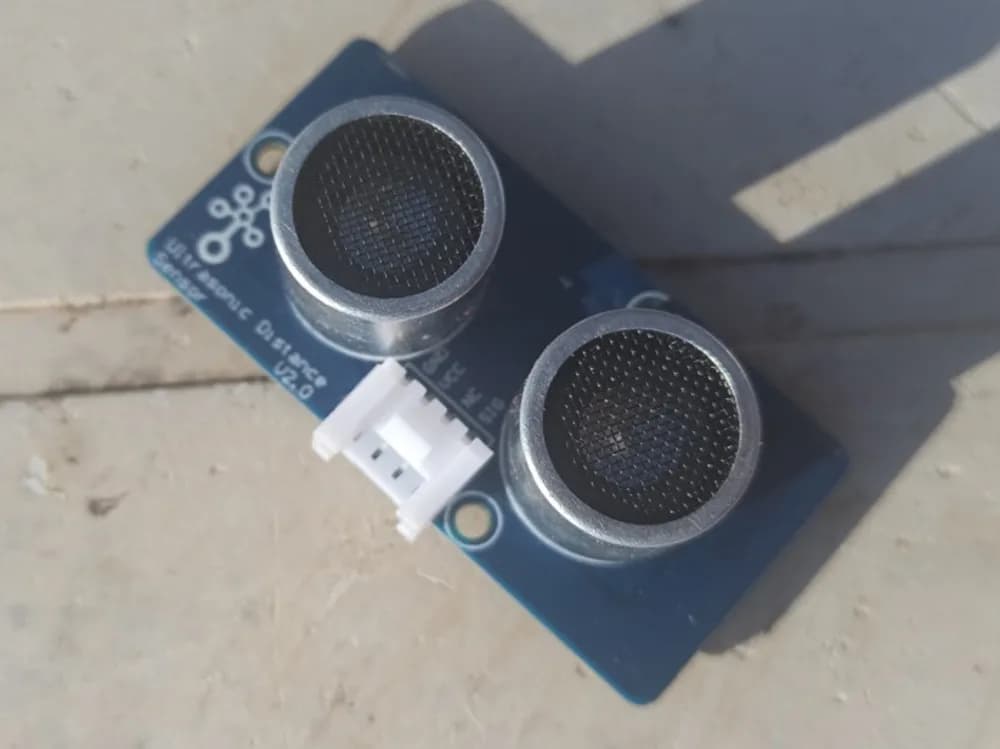
The ultrasonic sensor measures the distance to the water surface and shares power supply and signal line with the ESP01.
- TP4056: a linear lithium-ion battery charge controller with a constant-current/constant-voltage charging algorithm, temperature monitoring, and charge-status display — responsible for safely charging the battery via the solar panel.
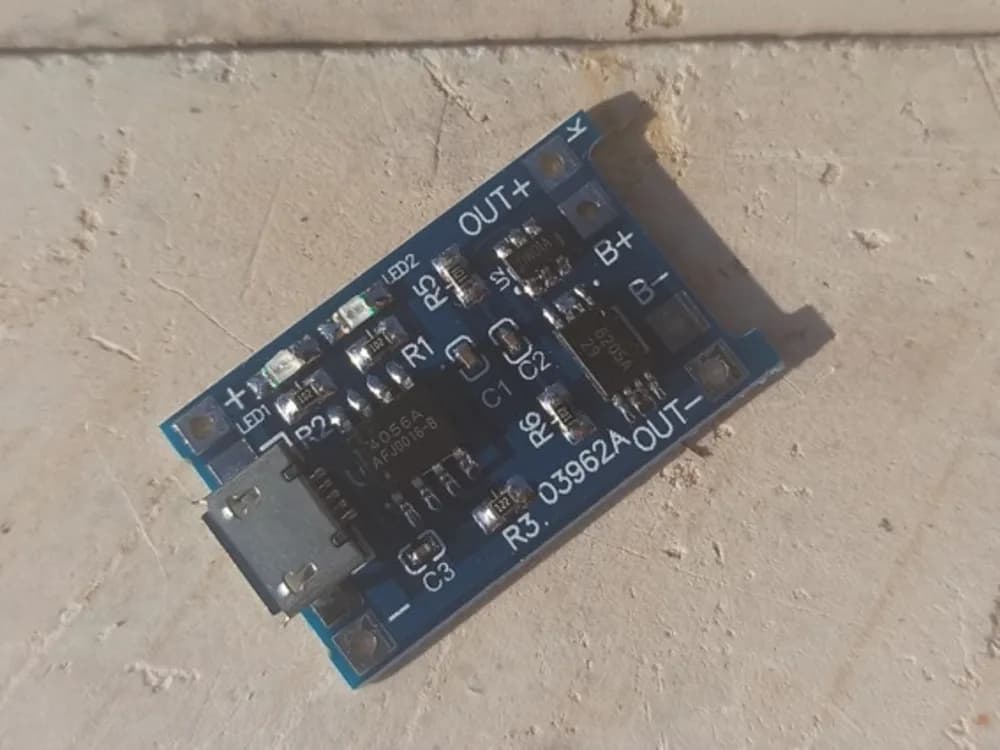
The TP4056 charging board charges the battery via the solar panel and handles voltage regulation for the ESP01 and sensor.
A few points remained open in the project, which I noted down as a task list — among them activating the deep-sleep mode of the ESP01, removing the status LEDs to lower power consumption further, removing the non-functioning battery display, adding a well-thought-out thermal management for the whole system, and properly documenting the hardware and software setup. Aqua Man thus remained an open project — but that's exactly part of maker projects on a farm: it's less about a finished product than about a working system that can be developed further.
Encounters that changed my view
Besides the work at the makerspace, it was above all the exchange with the other people on the farm that shaped these months. One particularly formative encounter was Paul Pricman, who also spent some time on the farm. He was working on a career in AI safety and researching the so-called alignment problem. Without my having to understand his technical work in detail, he prompted me to think about my own career goals and recommended a course from the Non-Trivial project. This encounter and my first engagement with effective altruism I've already processed in a separate article.
Later stops on the journey — such as visiting another Team Academy in Bilbao — additionally showed me that you can work and learn from very different places if you're open to it.
Reflection: when not everything goes according to plan
Not every phase of this stay went according to plan. Toward the end of the time on the farm, several things changed at once at short notice: my bicycle for the onward journey wasn't ready yet, and the stay ended earlier than originally intended. Instead of letting that slow me down, I translated the situation into a concrete task list — gather tools, repair the air pump, send parcels home, return the tent and sleeping bag — and worked through it point by point.
In hindsight, this handling of uncertainty is, for me, as much a part of the FabFarm as the makerspace and the water tanks: off-grid living also means dealing with short-term changes of plan and then organizing yourself again, step by step.
What I learned
Travel is a form of study. The six months from Portugal through Morocco to Bilbao showed me more than some lectures. The shift in perspective on your own surroundings — everyday life, consumption, work — is priceless and can hardly be replaced by reading alone.
Low-tech and electronics aren't mutually exclusive. A 2,000-liter water tank, an ultrasonic sensor, a solar panel, and a few euros of microcontroller are enough to turn an analog problem into a piece of automation — if you're willing to work with unfinished, further-developable solutions.
International networks grow out of real encounters. Whether off-grid enthusiasts like Chad, travelers like Aude and Martijn, or people with completely different professional backgrounds like Paul — on the FabFarm many perspectives came together that stayed with me even after the journey.
Even unfinished projects are worth documenting. Aqua Man was never fully finished — but it's exactly the open task list that shows how a project grows iteratively and what I could continue working on later.
Conclusion
The FabFarm near Lagos was, for me, more than just a stop on a journey: a place where off-grid living, makerspace culture, and an international exchange of ideas came together as a matter of course. Out of everyday life there, Aqua Man emerged as a small but concrete electronics project — and out of the encounters, such as with Paul, came new food for thought that reaches into my later projects.
The same maker approach — solving a concrete problem with simple means while leaving open what can be improved later — has accompanied me ever since, also in projects like the Steel Tongue MIDI Player or the network cabinet. And the experience that not everything goes according to plan, but that a task list almost always reveals a next step, still helps me today.