
Freundchen GmbH – SEO Website & Internationalization
August 31, 2025
This post was translated into English by AI. Read the original →
Project description
Freundchen GmbH rents out vacation apartments in Bremerhaven. The company is a spin-off from the GIF program: Paul Tonndorf, Marius Klein, and Falk Brischke started the idea as a student MVP with a single apartment from the cooperative and turned it into its own GmbH in 2022. Today several apartments are rented, renovated, furnished, and sublet to tourists.
Since the start of 2025 I've been part of the team — as a full-stack developer responsible for the conception and technical implementation of a new website. The project spanned two modules: building the SEO-optimized website and then its internationalization.
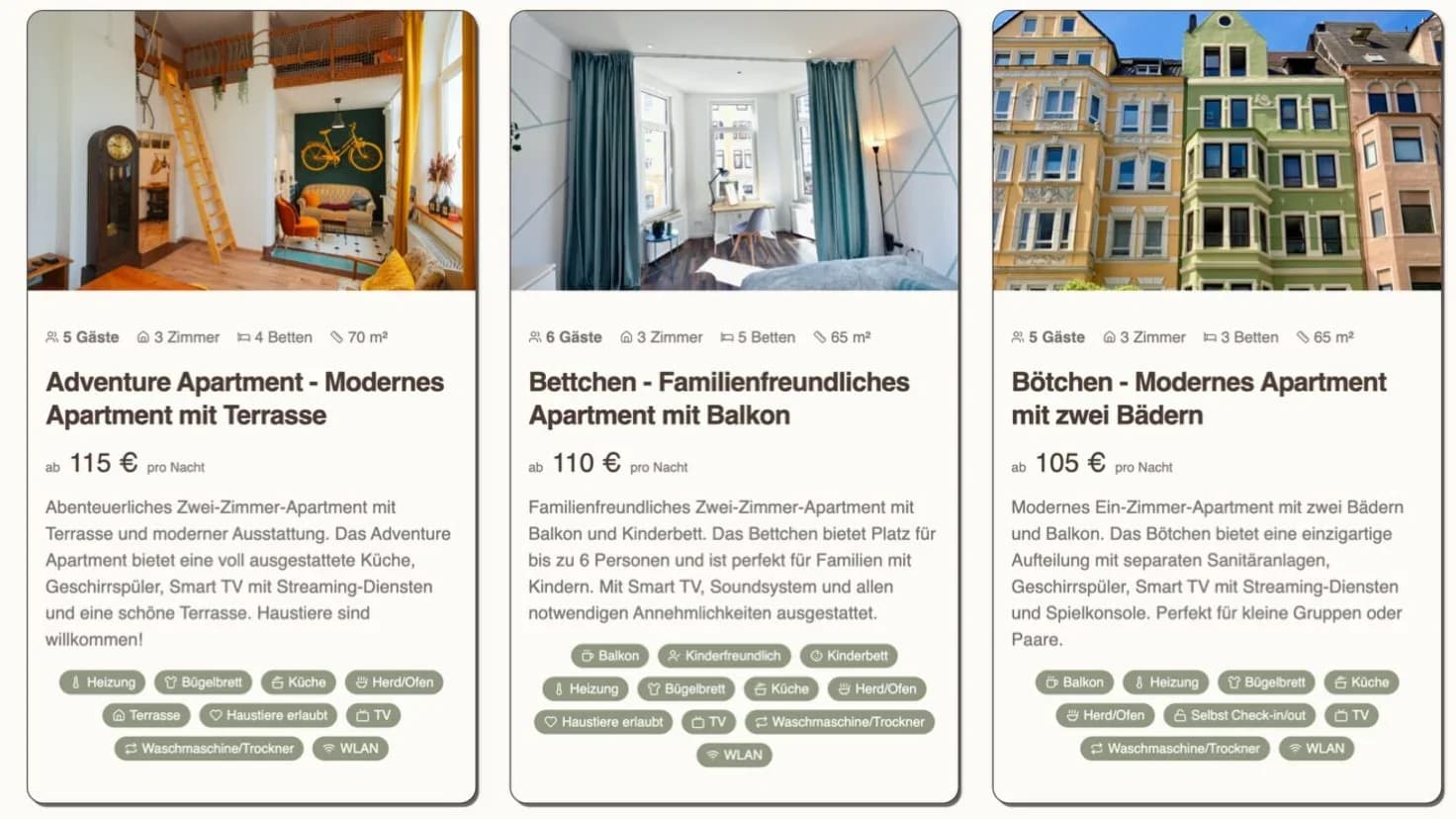
The prototype lists the apartments right on the homepage — with clear booking guidance instead of the generic website-builder look.
The problem: dependence on the platforms
The starting point was an uncomfortable realization: practically all bookings ran through online booking portals like Booking.com and Airbnb. Their commissions cost noticeable margin and create dependence on the platforms' rules and fees. Every booking through the company's own website, by contrast, would be considerably more profitable — and a step toward more independence.
The existing website, however, was automatically generated via Smoobu's website builder, allowed hardly any customization, and looked so untrustworthy that guests called to ask whether it was a scam. A clear sign of a poor conversion rate.
Goals
The project goal was redesigning an SEO-optimized website. Under it I placed two measurable figures — more visitors to the company's own site and a higher share of direct bookings — which I derived from the existing click rate and an industry-standard conversion rate. I'm deliberately keeping the concrete target values and business figures to myself; they served internally as orientation for the challenge period.
Analysis before the first line of code
Before designing, I conducted a market, competitor, keyword, and target-group analysis.
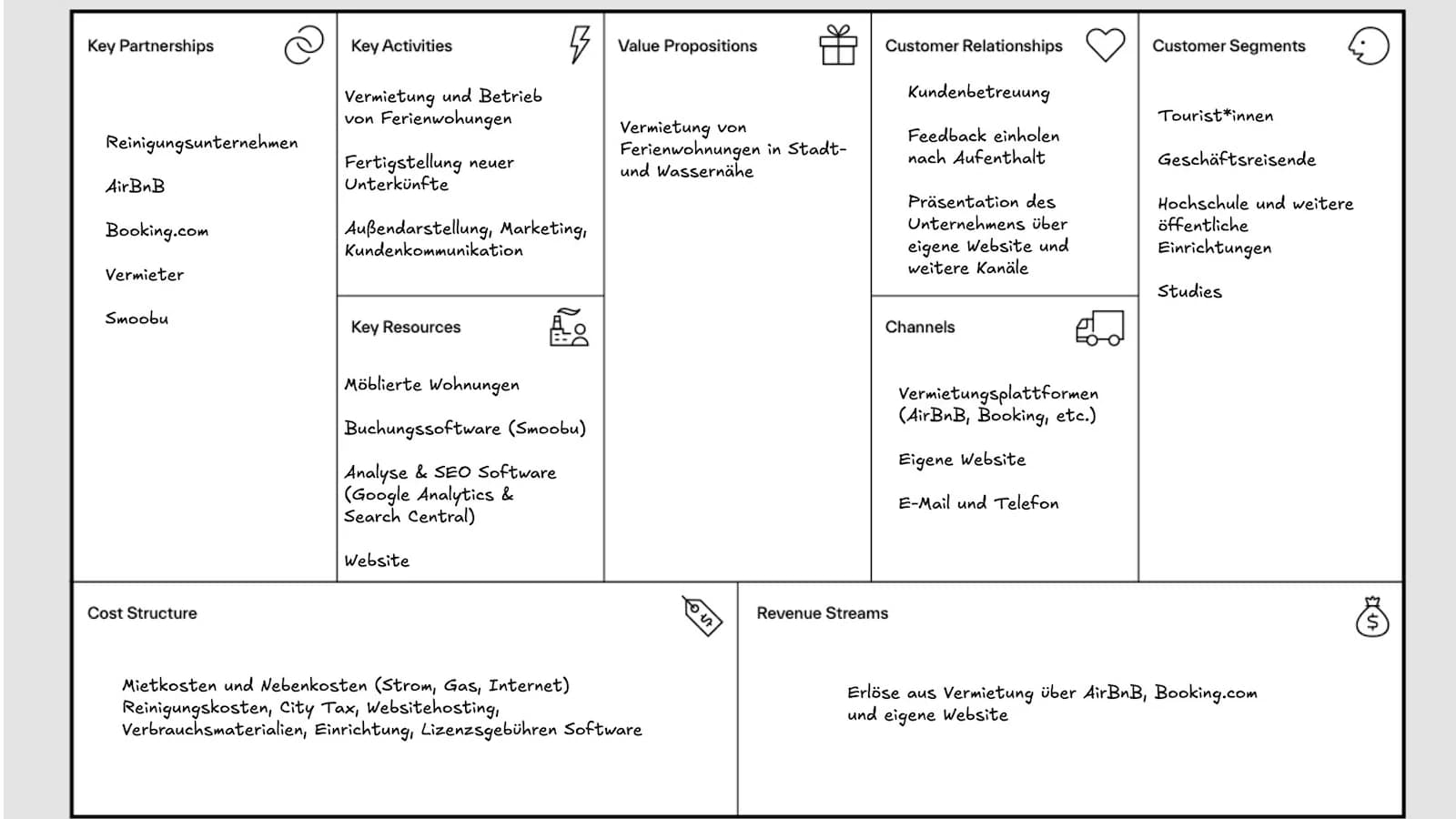
Besides the BMC for the rental business, a second canvas was created just for the website — it's at the center of the project.
Among the competitors, coast-house.de in particular was instructive: the site ranks for "Ferienwohnung Bremerhaven" right behind the big portals and relies on keyword clusters with dedicated subpages (/ferienwohnung-bremerhaven, /fewo-bremerhaven…). Notable: it does without the JSON-LD format recommended by Google — a gap I could do better on.
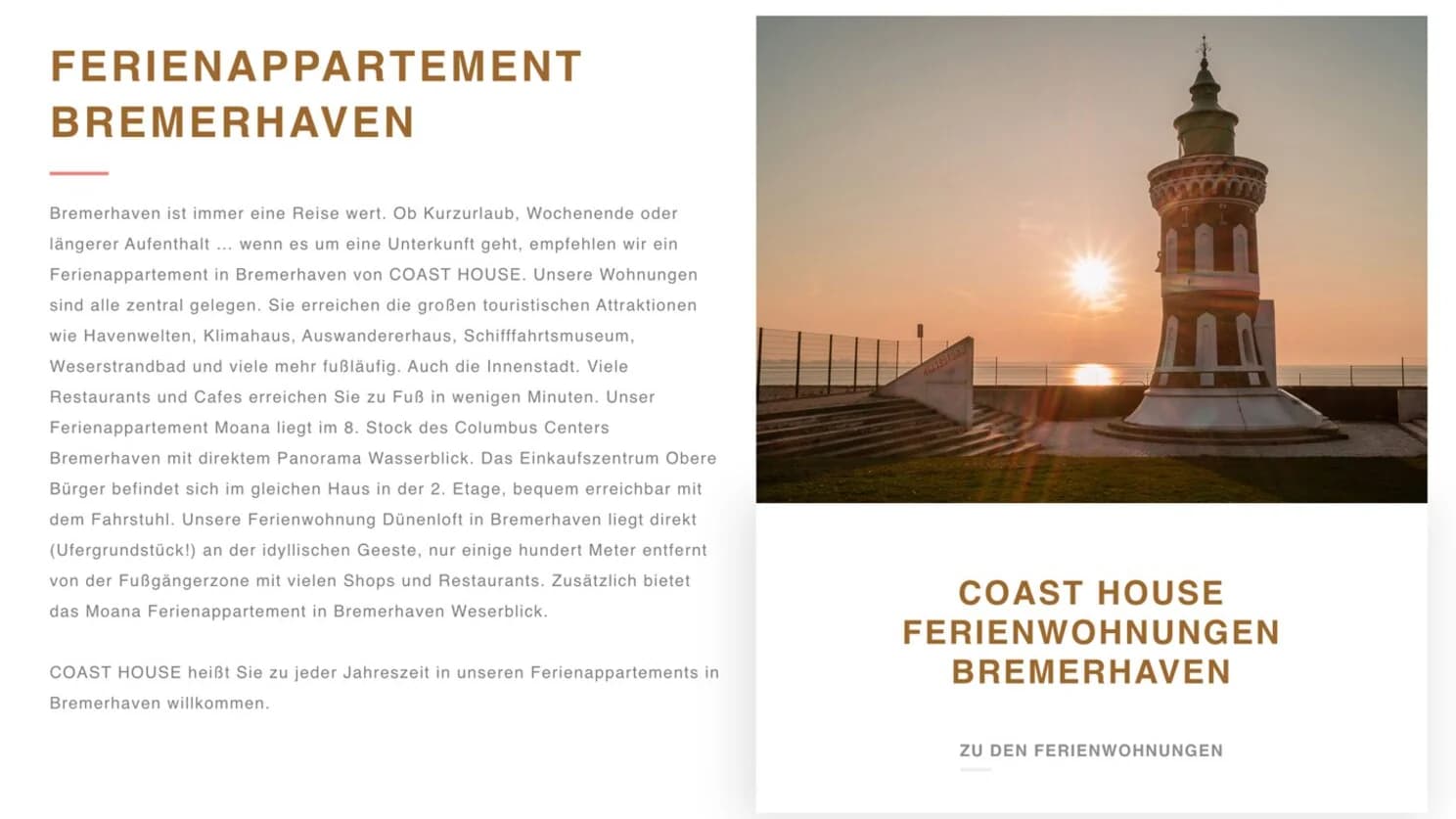
Competitors like Coast House provided inspiration for structure and keyword strategy.
From the keyword analysis (Google Search, Search Console, Trends, and Keyword Planner) I take away a nice insight: "ferienwohnung" and "ferienhäuser" are popular to different degrees regionally — in eastern Germany people search more for "ferienhäuser," in the west for "ferienwohnung." For regional campaigns, that's worth real money.
The technical decision: website builder or build it yourself?
The Smoobu website builder didn't do justice to my requirements — localization, A/B testing, technical SEO, and performance. In discussion (also with ChatGPT as a technical sparring partner), the decision fell on a self-coded approach with Next.js, Tailwind, and Vercel — without a CMS, with content in JSON files. For localization, next-intl came into question, for A/B testing PostHog, for structured data schema.org/JSON-LD.
This choice matched my experience: Webflow and Shopify were oversized or too inflexible for the purpose, while with Next.js I could work performantly, scalably, and cost-efficiently. The SEO measures included rich snippets via schema.org, Core Web Vitals, mobile-first, local keywords and backlinks, as well as informative blog posts for search queries with informational intent ("What to do in Bremerhaven with kids?"). On top of that: Google Hotel Ads, Google Business, and Analytics for evaluation.
A conversation with a friend who's an SEO expert brought the most important attitude: SEO is a long-term, strategic process. The technical base — page speed, mobile-first, a clean structure — helps with ranking, but many supposed tricks are outdated.
Part 2: Internationalization
With the website standing, the second module followed: internationalization with a focus on Denmark. The choice was data-based — measured by overnight stays in the state of Bremen and set in relation to population, Denmark has the most overnight stays proportionally. The Netherlands (good German skills) and Switzerland (German-speaking) thus dropped out as the primary target.
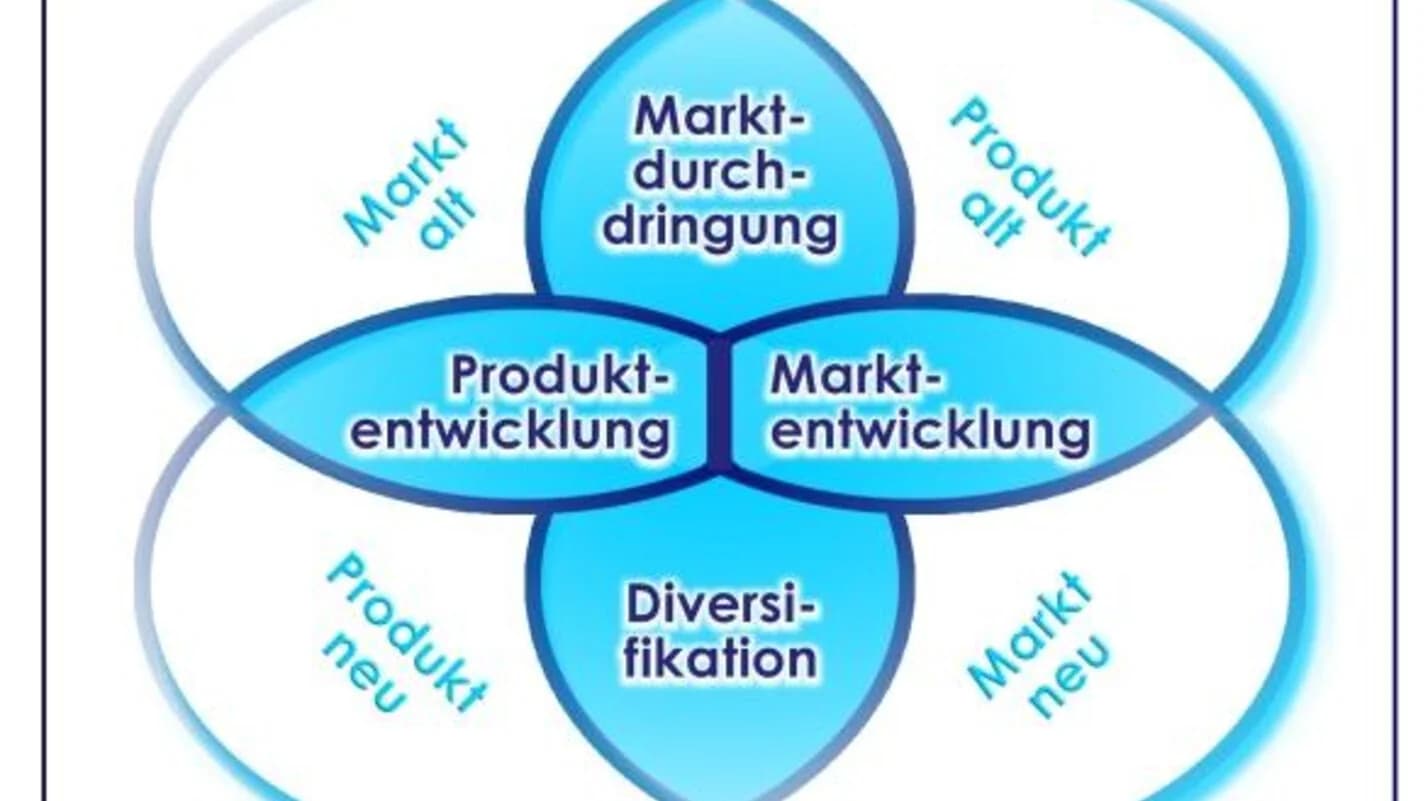
Strategically, renting to foreign guests is an "export of services" — an existing product opens up a new market (market development in the Ansoff matrix).
In theory I engaged with the forms of internationalization (export, license, franchising, joint venture, branch, subsidiary) and their levels of control, risk, and capital requirement. Since the place of service delivery stays in Bremerhaven, it's a pure export of services — a geographic expansion of the target group without a product change. Legally and fiscally, little changes as a result: Denmark is an EU and Schengen country, VAT and income tax still apply in Germany. It does make sense, though, to translate the imprint and privacy policy (Art. 12 GDPR) into the target language.
Transcreation instead of literal translation
Technically, I laid the foundation to not just translate content but to transcreate it — that is, to adapt tone, cultural context, and emotional effect. With the Hofstede model as a grid, I deliberately used Danish terms that resonate: hygge (coziness), afslapning (relaxation), autentisk oplevelse (authentic experience). Because WiFi and card payment are especially important to Danish guests, I built a dedicated Danish homepage that highlights exactly that.
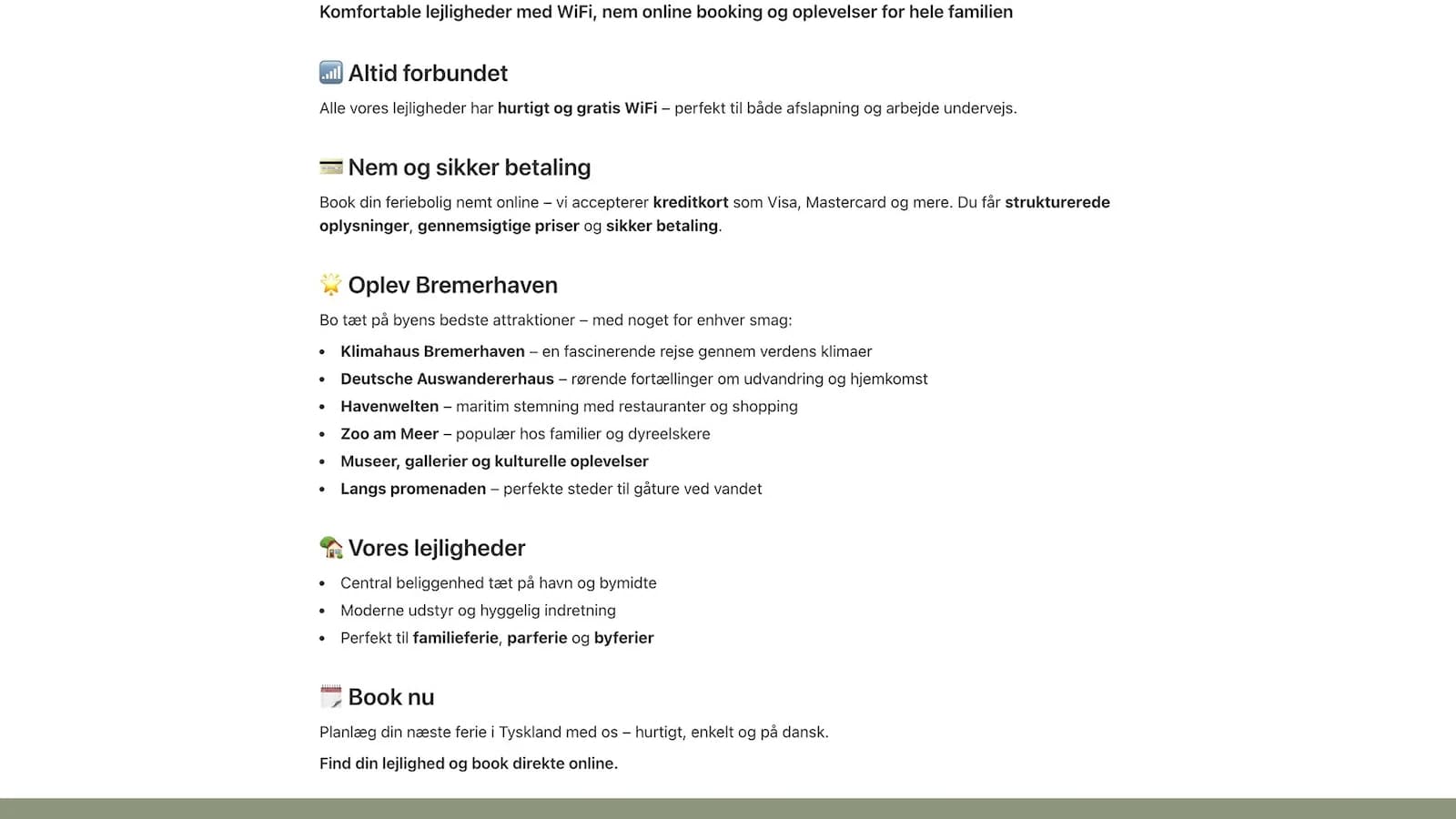
A specially transcreated homepage for the Danish market — with country-specific content instead of mere translation.
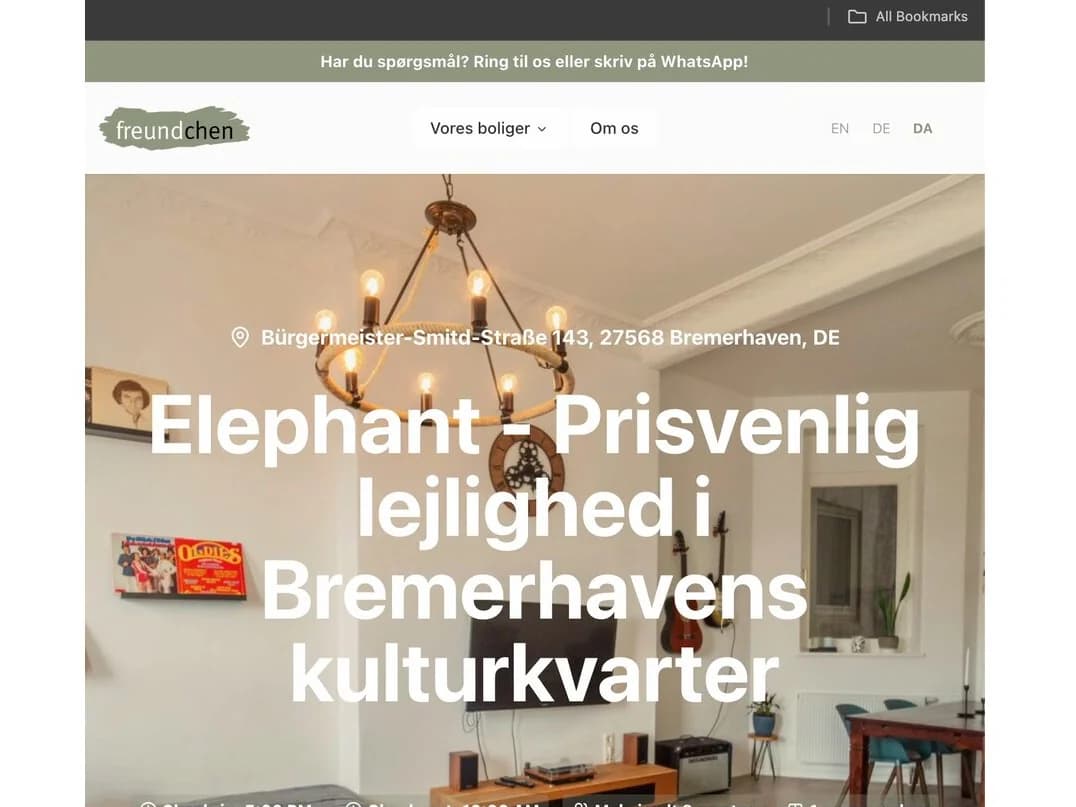
The individual apartments, too, were localized with Danish keywords like "lej en lejlighed i Bremerhaven med WiFi."
State of the project
The project didn't go live. What was created is a working, multilingual prototype based on Next.js — with significantly better performance, cleaner technical SEO, more appealing design, and a dedicated, transcreated variant for the Danish market. An internal Lighthouse comparison showed clear improvements over the old website-builder page in performance, SEO, and best practices.
That the site ultimately didn't go into production changes little about the project's value. It was an intensive learning project along the entire chain: from market and target-group analysis through the architecture decision to technical localization.
The argument behind the approach remains compelling: with a self-built base, an additional language costs almost nothing. For comparison, just the public prices of the alternatives — more than three languages with country-specific URLs cost around 289 € a month with Shopify, 29 € per language per month with Webflow, and some website builders (Wix, Squarespace) don't offer this quality at all. A self-built, open-source-based solution, by contrast, has hardly any running costs and could in principle be reused for other private vacation-rental providers, too.
What I learned
The project was, for me, the most comprehensive proof yet of how broad my profile has become: project responsibility, conception, technical implementation, SEO, and internationalization in one.
Building it yourself beats the website builder — when the requirements demand it. For i18n, technical SEO, A/B testing, and cost control, a custom Next.js solution was in the end more flexible and cheaper than any website builder.
SEO is strategy, not a trick. The technical base lays the foundation, but visibility emerges over the long term — and beware of promises that are too good.
Internationalization is more than translation. The Hofstede model and transcreation together are a powerful tool for communicating to a specific audience. My biggest loss in learning effect: direct contact with the Danish market came up short, so real intercultural experience partly stayed theoretical.
The technical depth of the web development behind it — why a custom Next.js architecture works so well for SEO and multilingualism — I explore in the article Next.js Rendering Strategies.