
Reimagining Finance for a Post-Growth Future
July 29, 2025

Introduction
Tari Wiencke Insights from Earth4All Deep-Dive Paper 29.07.2025
I recently introduced myself to the field of Post-Growth Entrepreneurship through a course by Melanie Rieback at the University of Amsterdam. With this, my interest in alternative non-extractive finance arose. In this essay, I want to further deepen my knowledge to find potential research questions for my bachelor thesis.
Investing to reconnect financial value with people, nature, and the real economy is a collection of papers from several organizations and got published by the Club of Rome. It is part of an initiative called Earth4All formed by the Club of Rome, the Potsdam Institute for Climate Impact Research, the Stockholm Resilience Centre, and the BI Norwegian Business School.
With the subtitle being An Interactive Blueprint for Capital Markets, Actors, Policymakers and Regulators, it presents a variety of actionable ideas. The Predistribution Initiative (PDI), Beyond Bretton Woods (BBW), and Africa Investor (Ai) try to give practical steps for institutional and private actors to reform the financial system as it is. The current economy is extremely financialized and disconnects financial markets from the real economy to an extent that is threatening society as a whole. This paper tries to answer the question of how to build a more regenerative and inclusive economy.
Earth4All and the Five Turnarounds
Earth4All identifies five extraordinary turnarounds that break trends of the past in significant ways and bring potential for real systems change:
- Eliminate poverty
- Reduce inequality
- Empower women
- Transform food systems
- Achieve energy security
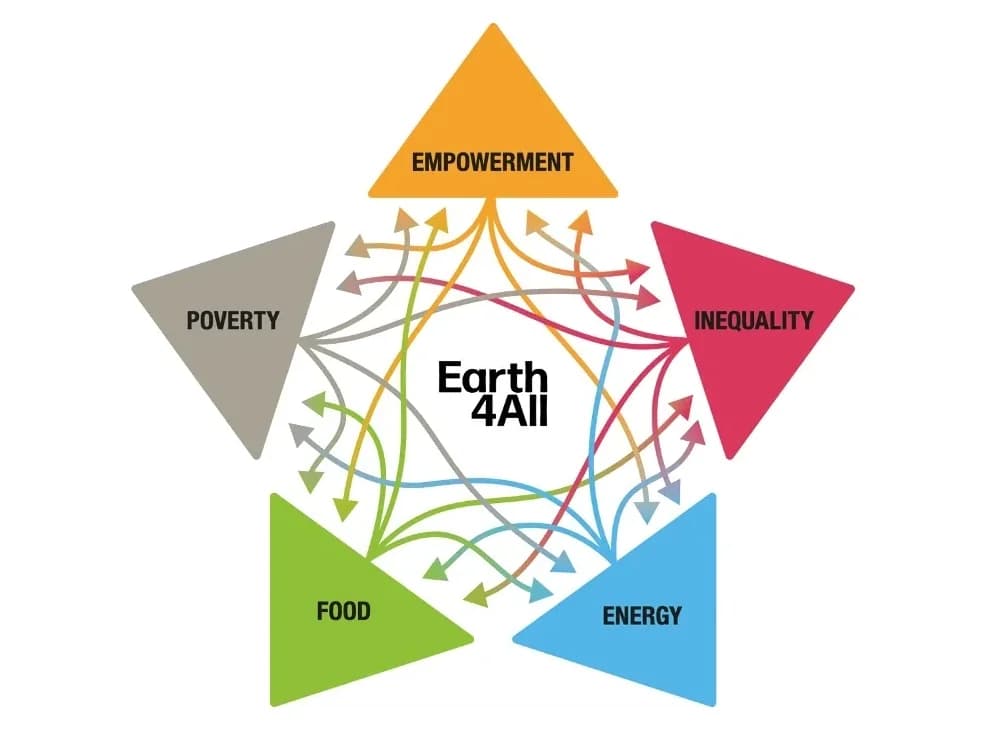
The first three guide on how to reform the capital market to distribute risk and return across stakeholders and nature. The latter, who are considered critical systems of production, can benefit from a reformed system.
Earth4All estimates that the costs of enacting the five turnarounds are much less than the risks of inaction. To achieve the so-called Giant Leap scenario by 2050, they estimate 2–4% of yearly GDP in funding is needed.
Since the financial system fuels global human activity, it can lead to great harm or great well-being in these global challenges. Therefore, capital market investors play a crucial role.
Redefining Fiduciary Duty
We need to reclaim the meaning of “fiduciary duty” and realign the role, purpose, and goal of capital markets. In the past, externalities like climate change and biodiversity loss were not included in fiduciary duty. But when it comes to pension funds, it becomes clear that they should be included, since those external risks are influencing the overall long-term performance of the fund. The concept of "mortgaging our futures" highlights how the prioritization of short-term returns today can come at the expense of returns for future generations. The idea of intergenerational fiduciary duty acknowledges that investment objectives should consider systemic long-term factors.
Investors need legal support to act according to this new interpretation of fiduciary duty. Furthermore, we need to develop new market infrastructure to scale up investments with contributions to sustainability goals.
Systemic Risk Analytics and Citizen Inclusion
Another field that needs innovation is the tools and methodologies used by the capital market to analyze risk and return. Currently, many accounting and financial analytics tools don’t integrate real-world systemic factors. We need to become clear about the question of what good looks like. Therefore, we need improved risk data for central banks and governments to understand what financial activities influence instability in our system.
In this transformation process, we need to include citizens around the world within all income layers and political views to bring back trust into institutional efforts. There are many good ideas for market reform, but rising inequality contributes to geopolitical tensions.
Those are just a few ideas covered in this highly informational paper. I am quite new to this topic and am going to need more time to grasp those key ideas. Through the reading of this paper, I found some more perspective for my role as an entrepreneur. I want to write my thesis on this topic. In there, I want to take a systemic approach to understand the financial system as a whole and want to recognize intervention points.
I am definitely going to use this paper as a foundation for my research. There are 137 references with plenty of literature to spend time on. It is so nice to see smart people bundle their efforts into changing the system for the better.
Entrepreneurial Interventions and Future Actions
As I reflect on the ideas discussed throughout the paper, I found some potential intervention points for my future entrepreneurial career:
- The paper shows that we need new tools that help investors make better choices. Choices that protect nature and support people. For example, platforms that show the long-term effects of investments or tools that help communities be part of financial decisions. As someone with a tech background, I could work on building digital tools that support this kind of positive change.
- Instead of using the usual model where only a few people profit, I’d like to create a business where workers, customers, or local communities can also benefit. This could mean shared ownership or giving part of the profits back to the people who helped create the value. I believe this is a fairer and more sustainable way to run a company. One technical solution to this idea could be Platform Coops where providers on a platform are also owners.